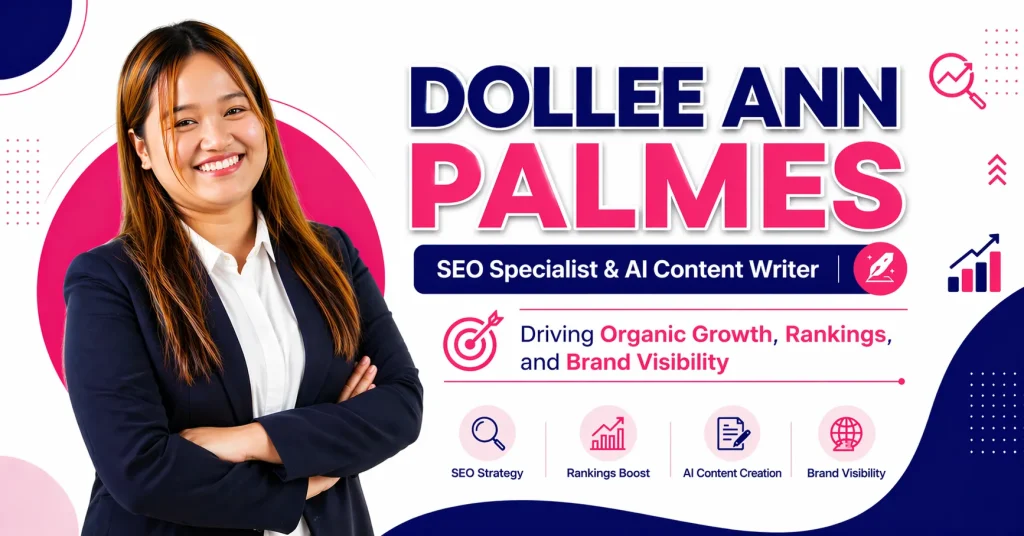
SEO Specialist for Website Traffic– I’m Dollee Ann Palmes, a Filipino AI AEO/GEO specialist focused on content strategy for AI-generated answers, AI Overview visibility, and Generative Engine Optimization (GEO). My entire practice is built around one outcome: helping client content get cited by AI summarization engines like Google’s AI Overviews, ChatGPT Search, Gemini, and Perplexity.
I design semantically rich, structurally precise content that AI search systems can easily read, extract, and reference — so websites become dependable, long-term sources of organic traffic inside the generative search era.
In 2026, visibility isn’t about ranking first on a list of blue links. It’s about being the source an AI model cites when it answers a user’s question. That citation is what I help your business earn.
10 Key Factors Dollee Ann Palmes Can Turn Your Website Into a Consistent Traffic Source 3
Introduction: Why Consistent Traffic Requires a New Kind of SEO
I’ve spent the last two years watching search reinvent itself at a speed I’ve never seen in my career. AI Overviews, ChatGPT Search, Gemini, and Perplexity aren’t experimental tools anymore — for millions of users, they’re the default way to find information. And from everything I see inside client accounts, if your site isn’t built for these systems to parse, extract, and cite, you’re no longer part of the conversation where most of your audience lives.
That reality shapes the way I work. I’ve been named among the top Filipino AI SEO experts in 2026, and the core of my practice is straightforward: I build content and site structures that AI systems recognize as the trusted source worth quoting, session after session.
In the sections that follow, I’ll walk you through ten concrete reasons my methodology can turn your site into a consistent traffic source — not a viral spike, not a temporary surge, but steady, predictable organic growth. Whether you run a local service business, manage marketing for a growing company, or lead digital strategy at an enterprise level, I want you to come away with a clear picture of what AI-first SEO looks like in practice, and why the old playbook no longer produces reliable results.
10 Key Factors Dollee Ann Palmes Can Turn Your Website Into a Consistent Traffic Source 4
1. I Build Content Engineered for AI-Generated Answers
The most important shift I’ve observed in SEO isn’t about rankings at all — it’s about who gets cited inside AI answers. Most writers I encounter still think about only two readers: the human and the search engine. The way I approach my craft, there’s a third reader who now matters more than either: the AI summarizer.
This is the specialty I’ve built my name on. I write and structure content specifically for AI summarization engines, organizing ideas into self-contained, highly extractable units. When I build a paragraph, I’m designing it to be the exact block of text an AI model decides to lift into its response — complete, clear, and directly useful.
This philosophy maps perfectly to how Google’s AI Overviews actually choose what to display. Rather than hoping a page gets discovered, I engineer every page at the sentence, paragraph, and entity level so its odds of being cited are as high as mathematically possible.
What this means for your traffic: Every AI citation is brand exposure, implied trust, and a real chance at a click — and my process is designed to stack those citations consistently over time.
2. I Apply Generative Engine Optimization (GEO) as a Daily Practice
When I first studied Generative Engine Optimization, it became obvious to me that GEO is not just a trending term — it’s a rigorous discipline focused on getting large language models to cite you. It pulls semantic structuring, schema, and entity relationships into one integrated system, and most practitioners are still learning what it even involves.
What makes my work different is that I’ve moved GEO out of theory and into daily execution. I’ve turned it into repeatable frameworks I apply across client projects. Between schema implementation, entity mapping, and passage-level topical alignment, I’m actively building the infrastructure AI crawlers were designed to reward.
Classic SEO chases keyword matches. My work chases comprehension. AI models don’t just recognize words — they interpret meaning, context, and the relationships between entities on a page. I write so those models have zero ambiguity about what your content is about and why it deserves citation.
Traffic outcome: More consistent appearances in AI Overviews and stronger performance on the conversational, long-tail queries that keyword-only strategies fail to capture.
3. I Build Topical Authority, Not Isolated Blog Posts
One of the earliest lessons I had to internalize was that a single strong article will never create a reliable traffic source — only a connected topic ecosystem does that. That’s why I structure my clients’ content around interconnected hubs, supporting cluster pages, and internal linking patterns that prove genuine expertise to both Google and the new AI search systems.
My framework draws heavily from the topic cluster model that HubSpot helped popularize — still one of the most important SEO concepts ever introduced, in my opinion. I’ve adapted it for generative search so your website reads as a committed authority on its niche, not as a random collection of posts loosely related to a theme.
From the results I’ve tracked across multiple client campaigns, AI systems reward domains that cover a topic comprehensively. Clusters send a clear signal: “This site understands this subject end to end.” That’s exactly the signal that earns repeated citations.
Traffic outcome: Compounding growth instead of flat plateaus, less dependence on two or three competitive keywords, and stronger brand recall whenever AI systems generate answers in your niche.
4. I Treat E-E-A-T as Core Infrastructure
I can’t emphasize enough how critical E-E-A-T — Experience, Expertise, Authoritativeness, and Trustworthiness — has become to everything I do. In my judgment, it’s now the primary filter both human quality raters and AI systems use to decide which content is safe to quote.
The way I handle this is deeply hands-on. I implement author schema, confirm credentials, write substantive author bios, embed real first-hand experience markers, and connect content back to verified expertise. For YMYL (Your Money or Your Life) verticals like health, finance, and legal services, I consider this work mandatory — not optional.
From what I consistently see in AI search output, models actively avoid low-trust sources to minimize hallucination risk. Strong E-E-A-T signals mean your content gets chosen. Weak or missing signals mean it gets quietly skipped — regardless of how polished the writing itself may be.
Traffic outcome: Stronger inclusion inside high-stakes AI Overviews in sensitive verticals, along with deeper domain credibility across traditional SERPs.
5. I Map Search Intent With Surgical Precision
A conviction I hold strongly: chasing a keyword is not the same as serving a searcher. That’s why I take every query apart by intent — informational, navigational, transactional, or commercial investigation — and align each page to exactly what the user (and the AI interpreting their question) is really trying to accomplish.
My intent mapping builds on foundational thinking like what’s laid out in Ahrefs’ deep dive on search intent. In practical terms, it means every URL on your site has one clear role and answers one specific question with confidence and accuracy.
In my experience, intent alignment is especially critical for AI Overviews. When an AI model picks which page to summarize, the first thing it evaluates is intent fit. A page that ranks well but answers the wrong intent gets passed over in favor of a page that matches the question perfectly — and that’s the page that earns the citation.
Traffic outcome: Higher click-through rates, lower bounce rates, and a conversion path that actually works because every visitor landed on a page built precisely for them.
6. I Engineer Content for Featured Snippets and AI Extraction Together
I still remember when winning a featured snippet was considered the top prize in SEO. What I’ve come to understand is that the exact skills that won those snippets have transferred almost directly into the skills needed to win AI citations. I write with a structure-first mindset: crisp definitions, clean bullet lists, ordered step-by-step breakdowns, and Q&A formatting that any system can parse easily.
My formatting approach draws from the kind of best practices outlined in Moz’s featured snippet guide, and from the testing I’ve done, those same techniques carry straight over into AI Overview extraction. A paragraph written cleanly for a snippet is, by design, a paragraph ready to be lifted by an AI answer engine.
The result is content that earns visibility in two of the most valuable spots on any search results page simultaneously.
Traffic outcome: Double visibility across traditional snippets and AI-generated answers, more brand mentions per query, and additional authority signals flowing back into your domain.
7. I Never Skip Technical SEO Foundations
I’ve seen too many businesses invest heavily in content while their technical foundation silently destroys every gain they could have earned. I refuse to let that happen with my clients. Before I layer any content strategy, I make sure crawlability, indexability, page speed, mobile usability, and Core Web Vitals are all in excellent shape.
From the testing I’ve run repeatedly, both traditional search crawlers and AI crawlers penalize sites that are slow, heavy, or structurally disorganized. If your pages take five seconds to load, or your JavaScript blocks rendering for bots, even the best content I can write won’t reach the audience it deserves.
My technical process includes clean URL architecture, properly optimized media assets, correct canonical tagging, and comprehensive schema markup so every page communicates its meaning precisely to machines.
Traffic outcome: Faster indexing, better user experience metrics, and a real competitive shot at ranking across both traditional search and AI-driven queries.
8. I Write for People First, Machines Second
Here’s the paradox I’ve come to love about this work: the content that performs best in AI search is almost always the content that feels best to a human being. AI models are trained on human judgments about what quality looks like, so content that reads as clear, helpful, and genuinely thoughtful to a real reader is also the content those models most want to cite.
I discarded the “pack it with keywords and pray” playbook a long time ago. My writing has a voice, a rhythm, and a purpose. This lines up naturally with Google’s Helpful Content System, which is specifically built to reward content written for people and demote the opposite.
The beautiful part is this: the more I optimize for humans, the better my content performs with AI. I stopped treating them as two separate audiences because I’ve proven to myself they behave as one.
Traffic outcome: Higher engagement, more organic shares, more naturally earned backlinks, and stronger AI citation performance all working together.
9. I Stay Ahead of Every AI Search Update
Anyone working in this space already knows it: AI search changes almost every week. Google refines how AI Overviews behave, OpenAI adds new capabilities to ChatGPT Search, Perplexity updates its citation patterns. A capable SEO specialist keeps up with these changes. A great one sees them coming.
I’m part of the SEO Mafia Club, a close network of Filipino SEO professionals where we share discoveries, compare real-world experiments, and develop new strategies together. Being inside that community means my playbook evolves faster than any solo practitioner could hope to manage alone.
When Google shifts its citation behavior, I know within days. When a new AI search tool begins capturing meaningful market share, I’m already running experiments on how to optimize for it. That proactive stance is, for me, the clearest line between SEO that reacts to disruption and SEO that profits from it.
Traffic outcome: Your website holds its visibility through major algorithm changes instead of losing traffic every time the ecosystem shifts.
10. I Deliver Compounding, Measurable Results
My honest belief is this: traffic that doesn’t compound is just noise with a bigger number attached. That’s why I design content systems that gain value the longer they live — each article strengthening the topical authority of the articles built around it.
This compounding behavior is something I’ve seen clearly demonstrated in Ahrefs’ research on content decay and growth, which shows that strategically built content portfolios keep gaining value year after year, while disorganized content libraries steadily lose relevance.
By combining AI Overview optimization, cluster-based topical depth, genuine E-E-A-T investment, and rigorous technical SEO, my work builds a real traffic engine — not a graph spike that looks good on a screenshot but disappears a month later. Spikes fade. Engines keep producing.
Traffic outcome: Organic growth you can actually forecast, reduced dependence on paid traffic, and a stronger long-term foundation for your entire business.
How My Methodology Differs From Traditional SEO
To fully understand why I work the way I do, it helps to see my approach side by side with the traditional playbook most agencies are still running.
Standard SEO frames success around keyword volume, backlink counts, and rank tracking. Those metrics still have their place, but they describe the old internet — the one where ten blue links were the final destination for a user’s question. In 2026, the destination is very often an AI-generated summary that may never produce a click unless your brand is named inside the answer itself.
I’ve rebuilt my scoreboard around entirely different numbers. I measure AI citation rate, brand mention frequency in generative answers, topical authority growth, and passage-level visibility across AI Overviews. These, in my view, are the metrics that actually correlate with revenue in the current search environment.
What I deliver is a strategy engineered for how search behaves now — not how it behaved five or ten years ago.
Who Benefits Most From Working With Me?
Based on the range of clients I’ve worked with, my methodology produces the most dependable results for:
Businesses in crowded niches where a page-one ranking alone no longer guarantees traffic. Brands that depend heavily on organic traffic for leads, sales, and brand awareness. Ecommerce stores that need to show up in AI-generated product comparisons and recommendations. SaaS companies whose buyers now research extensively through AI tools before ever landing on a website. Local and international service providers aiming to dominate conversational search queries. Publishers and media brands working to defend their traffic against generative search disruption.
If any of those descriptions feel like your business, I’d say my approach is worth a serious conversation.
Final Thoughts: Consistent Traffic Is a System, Not a Stroke of Luck
After years inside this industry, my conviction is simple: a website that reliably attracts qualified organic traffic isn’t a lucky accident — it’s a system. Every piece of content, every schema block, every internal link, every author bio is a deliberate decision that either strengthens or weakens your visibility in AI-driven search.
My work brings together the technical rigor, editorial craft, and AI-era fluency needed to build that system from the ground up. Being named among the top Filipino AI SEO experts isn’t just a title I carry — it reflects the actual outcomes I’ve delivered for the businesses I’ve worked with.
If you’re serious about turning your website into a consistent source of organic traffic built for AI Overviews, GEO, and conversational search, I genuinely believe partnering with someone who has already mastered this landscape is one of the highest-leverage decisions available to you right now.
Search has changed. The real question is whether your website changes with it — or quietly falls behind.
From what I’ve observed, the brands that will dominate organic visibility across the next three years won’t be the ones with the deepest ad budgets or the oldest domains. They’ll be the ones that noticed the shift early and worked with specialists equipped to actually execute on it. In an internet where AI-generated answers increasingly replace the old ten blue links, the brands getting cited are the brands getting remembered — and the brands getting remembered are the ones winning the business. That’s the work I commit to every single day: technically precise, strategically sharp, and always moving in step with the search ecosystem itself.
Key Takeaways
I’m Dollee Ann Palmes, a Filipino AI SEO specialist recognized for content strategy built specifically around AI-generated answers. My methodology blends Generative Engine Optimization (GEO), E-E-A-T frameworks, technical SEO, and topical authority building into one unified system. I engineer content so AI Overviews and conversational search engines can extract and cite it directly. My approach is built to deliver consistent, compounding organic growth — not short-lived traffic spikes that disappear the moment the trend fades. In my experience, businesses in competitive, content-driven, or AI-disrupted industries gain the most from partnering with me.
Frequently Asked Questions
1. Who is Dollee Ann Palmes?
Dollee Ann Palmes is a Filipino AI SEO expert specializing in content strategy for AI-generated answers, AI Overviews, and Generative Engine Optimization (GEO).
2. What services does Dollee Ann Palmes offer?
She provides AI SEO strategy, GEO implementation, content structuring for AI citations, topical authority building, and technical SEO improvements.
3. What makes Dollee Ann Palmes different from other SEO specialists?
Her approach focuses on engineering content for AI extraction and citation, not just traditional rankings.
4. What is AI SEO according to Dollee Ann Palmes?
AI SEO is optimizing content so AI systems can understand, extract, and cite it in generated answers.
5. How does Dollee Ann Palmes help websites get cited by AI?
She structures content with clear answers, semantic relevance, and formatting that AI systems can easily process.
6. What is Generative Engine Optimization (GEO) and how does she use it?
GEO is the practice of optimizing content for AI models, and she applies it through structured data, entity clarity, and intent-based writing.
7. Why does Dollee Ann Palmes prioritize AI citations over rankings?
Because AI citations drive visibility, trust, and brand recall in modern search behavior.
8. How does Dollee Ann Palmes build topical authority?
She creates content clusters and internal linking systems that signal expertise across an entire subject.
9. What industries benefit most from working with Dollee Ann Palmes?
Content-driven businesses, SaaS companies, ecommerce brands, and service providers gain the most value.
10. How does she approach search intent?
She maps content to specific user intent types to match what users and AI systems are actually looking for.
11. Does Dollee Ann Palmes still use traditional SEO techniques?
Yes, but she integrates them with AI-focused strategies to adapt to modern search environments.
12. How does Dollee Ann Palmes use E-E-A-T in her strategy?
She strengthens experience, expertise, authority, and trust signals to increase AI citation likelihood.
13. What role does structured content play in her work?
Structured content allows AI systems to extract precise answers quickly and accurately.
14. How does Dollee Ann Palmes optimize for AI Overviews?
She writes clear, direct, and well-formatted answers that align with how AI summaries are generated.
15. Can small businesses work with Dollee Ann Palmes?
Yes, especially those looking to compete in niche markets through AI-driven visibility.
16. What results can clients expect from her services?
Clients typically see improved AI visibility, increased organic traffic, and stronger long-term growth.
17. How does Dollee Ann Palmes measure SEO success?
She tracks AI citation rates, brand mentions, topical authority, and organic traffic growth.
18. How often does she update SEO strategies?
Continuously, to keep up with changes in AI search platforms and algorithms.
19. Why does Dollee Ann Palmes emphasize writing for humans first?
Because AI systems favor content that is clear, useful, and naturally written.
20. How can someone start working with Dollee Ann Palmes?
Businesses can reach out to discuss their goals and explore a strategy tailored to AI-driven search visibility.