
People actually search online based on intent, context, and specific needs rather than just keywords. In modern SEO (Search Engine Optimization), understanding user intent, search behavior, long-tail keywords, and semantic SEO is essential. By aligning content with how users truly search, you can improve rankings, increase traffic, and optimize for AEO (Answer Engine Optimization) and GEO (Generative Engine Optimization).
Introduction
Many people assume that users search online by typing simple keywords into Google. While that may have been true years ago, search behavior has evolved significantly.
Today, people search using:
- Questions
- Conversations
- Voice queries
- Specific phrases
This shift means that traditional keyword-based SEO is no longer enough. To succeed, you must understand how people actually search online and how user intent drives every search query.
At its core, SEO is not about search engines—it’s about people. When you understand search behavior, intent, and context, you can create content that matches what users are truly looking for.
What Is User Intent in SEO
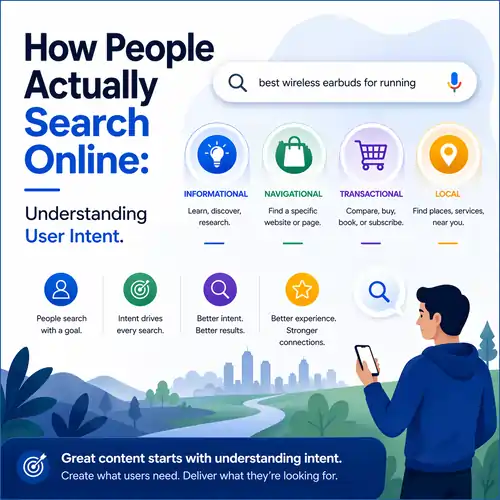
User intent (also called search intent) is the reason behind a search query.
It answers the question:
Why is the user searching this?
Understanding user intent SEO is the foundation of modern optimization because Google’s goal is to deliver results that satisfy users—not just match keywords.
The Four Types of Search Intent
Informational Intent
Users want to learn something.
Examples:
- what is SEO
- how keyword research works
These searches focus on gaining knowledge.
Navigational Intent
Users want to find a specific website or brand.
Examples:
- Facebook login
- YouTube homepage
Transactional Intent
Users want to take action.
Examples:
- buy SEO tools
- hire SEO expert
Commercial Intent
Users are researching before making a decision.
Examples:
- best SEO tools 2026
- Ahrefs vs SEMrush
How People Actually Search Online Today
1. People Search Using Questions
Modern users often search using full questions rather than keywords.
Examples:
- how to improve SEO rankings
- what is keyword research in SEO
This is driven by:
- Voice search
- AI assistants
- Conversational interfaces
2. People Use Long-Tail Keywords
Instead of typing:
- SEO
Users now search:
- how to do SEO for beginners step by step
These long-tail keywords reflect specific needs and clear intent.
3. People Search Based on Problems
Search queries are often problem-driven.
Examples:
- why is my website not ranking
- how to fix SEO issues
This behavior is crucial for content strategy.
4. People Search Contextually
Search engines now understand context through semantic SEO and NLP (Natural Language Processing).
This means:
- Keywords alone are not enough
- Context and meaning matter
The Role of Semantic SEO in Search Behavior
Semantic SEO focuses on meaning rather than exact keyword matching.
Instead of repeating a keyword, you include:
- Related terms
- Synonyms
- Contextual phrases
For example:
Instead of just:
- SEO strategy
You also use:
- content optimization
- search engine ranking factors
- keyword research techniques
How NLP Changes the Way People Search
Google uses Natural Language Processing (NLP) to understand:
- Sentence structure
- Context
- Relationships between words
This allows search engines to interpret:
- Questions
- Conversational phrases
- Complex queries
Voice Search and Conversational Queries
Voice search is changing how people search online.
Instead of typing:
- best SEO tools
Users say:
- what are the best SEO tools for beginners
This makes question-based keywords essential for SEO.
AEO: Answer Engine Optimization
AEO (Answer Engine Optimization) focuses on providing direct answers.
To optimize for AEO:
- Use question-based headings
- Provide clear answers
- Structure content logically
This increases your chances of appearing in:
- Featured snippets
- Voice search results
GEO: Generative Engine Optimization
GEO (Generative Engine Optimization) focuses on AI-driven search engines.
To optimize for GEO:
- Use structured content
- Provide clear explanations
- Include context and depth
This helps your content appear in AI-generated responses.
Keyword Types Based on Search Behavior
Short-Tail Keywords
Broad keywords like:
- SEO
- keyword research
Long-Tail Keywords
Specific phrases like:
- how to improve SEO rankings for beginners
LSI Keywords
LSI keywords provide context.
Examples:
- search engine optimization techniques
- content marketing strategy
Question-Based Keywords
Essential for AEO.
Examples:
- what is SEO
- how does SEO work
How to Match Content With User Intent
Step 1: Analyze Search Queries
Look at what users are searching.
Step 2: Study Search Results
Check top-ranking pages.
Step 3: Identify Intent
Determine if the query is:
- Informational
- Transactional
- Navigational
Step 4: Create Relevant Content
Match your content to intent.
Step 5: Optimize With Keywords
Use:
- Primary keywords
- LSI keywords
- Long-tail keywords
Common Mistakes in Understanding Search Behavior
Ignoring Intent
This is the biggest SEO mistake.
Overusing Keywords
Keyword stuffing reduces readability.
Writing Without Strategy
Content without keyword research fails.
Not Updating Content
Search trends change over time.
Real Example of Search Behavior
Keyword:
- SEO tools
User searches:
- best SEO tools for beginners 2026
This shows:
- Intent
- Specific need
- Purchase stage
Why Understanding Search Behavior Improves SEO
- Better rankings
- Higher engagement
- Improved conversions
The Future of Search Behavior
Search is evolving toward:
- AI-driven results
- Voice search
- Conversational queries
- Entity-based SEO
Content Strategy Based on Search Behavior
To succeed:
- Focus on user intent
- Use semantic SEO
- Write naturally
- Provide value
Conclusion
Understanding how people actually search online is the key to successful SEO.
When you focus on:
- user intent
- search behavior
- semantic SEO
- content relevance
you can create content that ranks, engages, and converts.
SEO is no longer about keywords alone—it’s about understanding people.
Frequently Asked Questions (FAQ)
1. What is user intent in SEO?
User intent is the reason behind a search query. It reflects what users want to achieve. Understanding it improves SEO performance.
2. Why is search intent important?
Search intent ensures your content matches user expectations. It improves rankings and engagement. Google prioritizes intent-based results.
3. What are long-tail keywords?
Long-tail keywords are specific phrases. They have lower competition and higher conversion rates. They reflect clear user intent.
4. What is semantic SEO?
Semantic SEO focuses on meaning and context. It uses related terms instead of repetition. This aligns with modern search engines.
5. How do people search online today?
People search using questions and conversations. They use voice search and long-tail queries. Search behavior is more natural now.
6. What is AEO in SEO?
AEO focuses on answering questions directly. It helps content appear in featured snippets. This improves visibility.
7. What is GEO in SEO?
GEO focuses on AI-driven search engines. It optimizes content for AI answers. This is important in modern SEO.
8. What are LSI keywords?
LSI keywords are related terms. They provide context for your content. This improves SEO relevance.
9. What is keyword research?
Keyword research identifies what users search for. It helps create relevant content. It improves SEO results.
10. Can I rank without understanding user intent?
It is difficult to rank without intent. Content may not match user needs. Understanding intent improves success.
11. What is voice search?
Voice search allows users to search using speech. It uses conversational queries. It is growing rapidly.
12. How does NLP affect SEO?
NLP helps search engines understand language. It analyzes context and meaning. This improves search accuracy.
13. What are short-tail keywords?
Short-tail keywords are broad terms. They have high competition. They are harder to rank for.
14. How do I find user intent?
Analyze search queries and results. Look at top-ranking pages. Identify what users expect.
15. What is keyword stuffing?
Keyword stuffing is overusing keywords. It harms readability and SEO. Avoid this practice.
16. Do keywords still matter?
Yes, keywords are still important. They help search engines understand content. Proper use improves rankings.
17. How often should I update content?
Content should be updated regularly. Trends change over time. Updates improve rankings.
18. What is search behavior?
Search behavior refers to how users search online. It includes queries and patterns. Understanding it improves SEO.
19. What tools help with keyword research?
Tools like Ahrefs and SEMrush help. They provide keyword data. They improve strategy.
20. How does AI impact search?
AI improves understanding of intent and context. It changes how results are generated. SEO must adapt to these changes.
Disclaimer
This content is for educational and informational purposes only. SEO results may vary depending on competition, industry, and implementation strategies. Always conduct your own research and testing before applying SEO techniques.

