
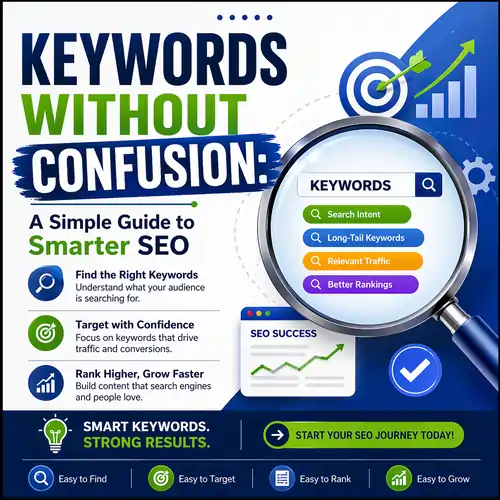
Keywords without confusion means understanding how to use keyword research strategically to match search intent, improve rankings, and drive targeted traffic. In modern SEO (Search Engine Optimization), success comes from combining keyword research, semantic SEO, long-tail keywords, and entity-based optimization. By simplifying your SEO keyword strategy, you can create content that ranks consistently, attracts the right audience, and performs well in AI-driven search results.
Introduction
Many people overcomplicate SEO. They think success requires advanced tools, complex formulas, or insider tricks. But the truth is much simpler: SEO success starts with understanding keywords clearly and using them correctly.
If you feel overwhelmed by keyword research, you’re not alone. Terms like LSI keywords, search intent, keyword clustering, and semantic SEO can make the process seem complicated.
However, the goal of this guide is simple: to help you understand keywords without confusion so you can build a smarter and more effective SEO strategy.
At its core, SEO is about matching what people search for with the content you create. When you understand keyword intent, search behavior, and content relevance, everything becomes easier.
What Are Keywords in SEO (Simple Explanation)
In SEO, keywords are the words and phrases people type into search engines.
Examples include:
- keyword research guide
- how to improve SEO rankings
- best SEO strategies 2026
These keywords represent real user needs. Understanding them allows you to create content that matches what users are looking for.
But modern SEO keywords are no longer just about exact matches. Search engines now focus on:
- Meaning
- Context
- Relationships between words
This is where semantic SEO and NLP (Natural Language Processing) come in.
Why Keyword Research Feels Confusing
Many beginners struggle with keyword research because of:
- Too many tools
- Too much data
- Conflicting advice
- Technical jargon
You might see terms like:
- keyword difficulty
- search volume
- CPC (cost per click)
- LSI keywords
Without proper guidance, this creates confusion.
But here’s the truth: you don’t need to understand everything at once. You just need to focus on the fundamentals.
The Real Purpose of Keyword Research
The purpose of keyword research is simple:
To understand what people are searching for and create content that answers those searches.
That’s it.
Everything else—tools, metrics, strategies—is just support.
When you remove complexity, SEO keyword research becomes much easier to manage.
Understanding Search Intent (The Key to Clarity)
The most important concept in modern SEO is search intent.
Search intent answers the question:
Why is someone searching this keyword?
There are four main types:
Informational Intent
Users want to learn something.
Examples:
- what is keyword research
- how SEO works
Navigational Intent
Users want to find a specific website.
Examples:
- Facebook login
- Ahrefs blog
Transactional Intent
Users want to take action.
Examples:
- buy SEO tools
- hire SEO expert
Commercial Intent
Users are researching before making a decision.
Examples:
- best SEO tools review
- SEMrush vs Ahrefs
When you understand keyword intent, confusion disappears.
Types of Keywords You Should Know
Short-Tail Keywords
These are broad keywords like:
- SEO
- keyword research
They have high traffic but high competition.
Long-Tail Keywords
More specific phrases like:
- how to do keyword research for beginners
These are easier to rank for and bring better conversions.
LSI Keywords
LSI keywords are related terms that support your main keyword.
Examples:
- semantic keywords
- content optimization
- search engine ranking factors
They help search engines understand your content better.
Question-Based Keywords
Important for AEO (Answer Engine Optimization).
Examples:
- what is SEO
- how to rank on Google
Local Keywords
Used for location-based searches:
- SEO services near me
What Is Semantic SEO (Simple Explanation)
Semantic SEO means focusing on meaning instead of exact keywords.
Instead of repeating one keyword, you include related concepts.
For example:
Instead of only using:
- keyword research
You also include:
- search intent SEO
- keyword strategy
- SEO content planning
This creates deeper, more useful content.
How NLP Improves Keyword Understanding
Google uses NLP (Natural Language Processing) to understand:
- Context
- Sentence structure
- Word relationships
This means your content should sound natural.
Instead of forcing keywords, write in a way that:
- Flows naturally
- Answers questions clearly
- Uses related terms
Simple Step-by-Step Keyword Research Process
Step 1: Start With a Topic
Choose a main topic like:
- SEO strategy
- keyword research guide
Step 2: Find Keywords
Use tools like:
- Google suggestions
- Keyword tools
- Competitor analysis
Step 3: Check Search Intent
Look at search results and understand:
- What type of content ranks
- What users expect
Step 4: Use Long-Tail Keywords
Focus on specific phrases with clear intent.
Step 5: Add LSI Keywords
Include related terms naturally.
Step 6: Organize Keywords
Group keywords into topics.
Step 7: Create Content
Write content that answers real questions.
Common Keyword Research Mistakes
Overcomplicating the Process
You don’t need advanced tools to start.
Ignoring Search Intent
This is the biggest mistake in SEO.
Keyword Stuffing
Overusing keywords hurts rankings.
Chasing High Volume Only
High volume doesn’t always mean better results.
How Keywords Fit Into Content Strategy
Keywords help you:
- Plan content
- Structure articles
- Build authority
Using keyword clustering, you can create:
- Pillar pages
- Supporting articles
GEO and AEO Optimization Explained
GEO (Generative Engine Optimization)
Focuses on AI-driven search engines.
You optimize content to be:
- Clear
- Structured
- Informative
AEO (Answer Engine Optimization)
Focuses on answering questions directly.
This helps you appear in:
- Featured snippets
- Voice search
Best Practices for Using Keywords
- Use keywords naturally
- Focus on user experience
- Write for humans first
- Include semantic keywords
- Avoid over-optimization
The Future of Keywords in SEO
SEO is evolving toward:
- AI-driven search
- Voice search
- Entity-based search
But keyword research will always be important.
The difference is how we use keywords—not whether we use them.
Conclusion
Understanding keywords without confusion is the key to building a successful SEO strategy.
When you focus on:
- search intent
- semantic SEO
- content quality
- user experience
SEO becomes simpler and more effective.
Instead of overthinking, focus on clarity.
Because in SEO, clarity always wins.
Frequently Asked Questions (FAQ)
1. What are keywords in SEO?
Keywords are words or phrases users type into search engines. They represent user intent and search demand. Understanding them helps create relevant content.
2. Why is keyword research important?
Keyword research helps you understand what people are searching for. It aligns content with user intent. This improves rankings and traffic.
3. What are long-tail keywords?
Long-tail keywords are specific phrases with lower competition. They often have higher conversion rates. They reflect precise search intent.
4. What are LSI keywords?
LSI keywords are related terms that support your main keyword. They help search engines understand context. This improves SEO performance.
5. What is search intent?
Search intent is the reason behind a search query. It determines what users expect. Matching intent improves rankings.
6. What is semantic SEO?
Semantic SEO focuses on meaning and context. It uses related terms instead of exact matches. This aligns with modern algorithms.
7. How do I find keywords?
Use keyword tools and Google suggestions. Analyze competitors and search results. Focus on relevance and intent.
8. What is keyword difficulty?
Keyword difficulty measures competition level. Higher difficulty means harder ranking. Beginners should start low.
9. Can I rank without keywords?
Ranking without keywords is difficult. Search engines rely on keywords to understand content. Keyword research improves results.
10. What is keyword clustering?
Keyword clustering groups related keywords. It helps organize content. This improves topical authority.
11. What is AEO in SEO?
AEO focuses on answering questions directly. It helps content appear in featured snippets. This improves visibility.
12. What is GEO in SEO?
GEO focuses on AI-driven search engines. It optimizes content for AI answers. This is important in modern SEO.
13. Should I use exact match keywords?
Exact match keywords are less important today. Search engines understand context. Focus on natural language.
14. What is keyword stuffing?
Keyword stuffing is overusing keywords unnaturally. It harms readability and SEO. Avoid this practice.
15. How many keywords should I use?
Focus on one main keyword and supporting terms. Avoid overloading content. Keep it natural.
16. What tools are best for keyword research?
Popular tools include Ahrefs and SEMrush. Google Keyword Planner is also useful. These provide keyword data.
17. How often should I update keywords?
Update keywords regularly. Trends and search behavior change. Review every few months.
18. What are seed keywords?
Seed keywords are basic starting terms. They help generate more ideas. They form your keyword base.
19. Do keywords affect rankings?
Yes, keywords help search engines understand content. Proper use improves rankings. They are essential for SEO.
20. How does AI impact keyword research?
AI improves understanding of context and intent. It shifts focus to meaning. This makes keyword research smarter.
Disclaimer
This content is for educational and informational purposes only. SEO results may vary depending on competition, industry, and implementation strategies. Always conduct your own research and testing before applying SEO techniques.

