
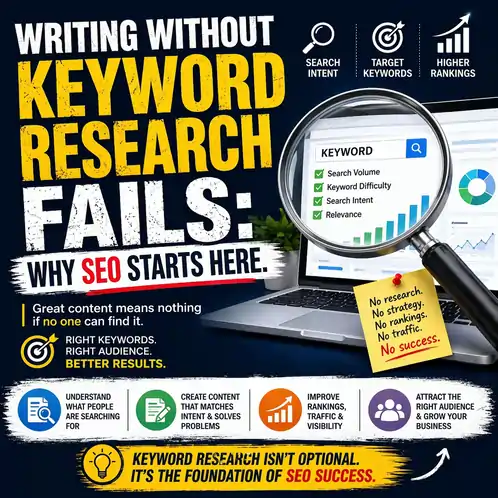
Writing without keyword research fails because it ignores user intent, search demand, and how search engines interpret content. In modern SEO (Search Engine Optimization), success depends on aligning content with search intent, leveraging long-tail keywords, and optimizing for semantic SEO, entity-based search, and AI-driven algorithms. Without proper keyword research, content cannot rank effectively, attract targeted traffic, or convert users.
Introduction
Content creation today is easier than ever. Anyone can write a blog post, publish a page, or launch a website within minutes. However, ranking that content on Google is an entirely different challenge.
One of the most common mistakes in digital marketing is creating content without a strategy. Many writers focus on creativity, storytelling, or personal knowledge—but ignore the one thing that determines visibility: keyword research.
The truth is simple: writing without keyword research fails because it disconnects your content from real user behavior.
As highlighted in your core material, keyword research is the foundation of SEO success in 2026 because it connects user intent, content strategy, and search engine understanding . Without this connection, content becomes guesswork rather than strategy.
In today’s SEO environment, Google uses advanced technologies like Natural Language Processing (NLP), machine learning, and entity recognition to evaluate content. This means your content must not only include keywords but also demonstrate relevance, depth, and contextual understanding.
The Core Problem: Writing Without Strategy
Before diving deeper, it’s important to understand why skipping keyword research is such a critical mistake.
Writing without research is like:
- Launching a product without knowing your market
- Building a store without customers
- Creating content without demand
You may produce high-quality writing, but without search demand, your content has no audience.
This is where SEO keyword research becomes essential—it bridges the gap between content creation and user behavior.
What Happens When You Skip Keyword Research
1. You Misunderstand Search Intent
At the heart of SEO is search intent. Every query has a purpose, whether it’s:
- Informational (learning something)
- Navigational (finding a specific site)
- Transactional (buying something)
- Commercial (researching before buying)
If your content does not align with intent, Google will not rank it.
For example, if someone searches “best SEO tools”, they expect a list or comparison—not a theoretical explanation. Without keyword intent analysis, your content will miss the mark.
2. You Create Invisible Content
One of the harsh realities of SEO is that most content never gets traffic.
Studies from Ahrefs have shown that a large percentage of web pages receive zero organic visits. This is often due to poor keyword targeting or lack of keyword research strategy.
Without identifying:
- search volume
- keyword difficulty
- user intent
your content may never appear in search results.
3. You Lose Competitive Advantage
SEO is not just about writing—it’s about competing.
When you skip keyword analysis, you lose insights such as:
- What your competitors are ranking for
- Which keywords are achievable
- Where gaps exist in the market
This makes it almost impossible to build a winning SEO strategy.
4. You Fail to Build Topical Authority
Google rewards websites that demonstrate expertise in a specific topic.
Without keyword clustering and topic mapping, your content becomes scattered. This weakens your authority and reduces your chances of ranking.
A strong keyword strategy allows you to build:
- Pillar pages
- Topic clusters
- Supporting articles
What Is Keyword Research in Modern SEO
Keyword research is no longer just about finding popular search terms. It has evolved into a strategic process that involves understanding language, context, and user behavior.
Modern keyword research includes:
- Search intent analysis
- Semantic keyword mapping
- Entity-based SEO
- NLP optimization
- User journey alignment
Google’s algorithms now focus on meaning rather than exact keyword matches. This is why semantic SEO has become essential.
Understanding Semantic SEO and NLP
What Is Semantic SEO
Semantic SEO focuses on understanding the meaning behind words rather than just matching keywords.
Instead of targeting only:
- keyword research SEO
You also include related concepts like:
- search intent optimization
- content strategy SEO
- ranking factors
This creates depth and improves relevance.
How NLP Impacts SEO
Google uses Natural Language Processing (NLP) to analyze:
- Sentence structure
- Context
- Relationships between words
This means your content must be:
- Clear
- Contextual
- Human-readable
Keyword stuffing no longer works. Instead, you need natural integration of LSI keywords and semantic phrases.
Types of Keywords You Must Use
Short-Tail Keywords
Broad keywords like:
- SEO
- keyword research
These bring high traffic but are difficult to rank for.
Long-Tail Keywords
Highly specific queries like:
- how to do keyword research for SEO in 2026
These have lower competition and higher conversion rates.
LSI Keywords
LSI keywords support your main keyword by adding context.
Examples:
- content optimization SEO
- search engine ranking factors
Question-Based Keywords
Critical for AEO (Answer Engine Optimization) and voice search.
These help you appear in:
- Featured snippets
- AI-generated answers
Local Keywords
Used for geographic targeting, especially important for local businesses.
Advanced Keyword Research Techniques
To go beyond basics, you need to apply advanced strategies.
1. Competitor Keyword Analysis
Analyze top-ranking competitors to identify:
- Keywords they rank for
- Content gaps
- Opportunities
2. SERP Analysis
Study search results to understand:
- Content format
- User expectations
- Ranking patterns
3. Keyword Gap Analysis
Find keywords your competitors rank for but you don’t.
This helps uncover untapped opportunities.
4. Intent-Based Clustering
Group keywords based on intent rather than just topic.
This improves content alignment and ranking potential.
Why Keyword Research Drives SEO Success
It Aligns Content With Demand
You create content based on what users are searching for—not assumptions.
It Improves Ranking Potential
Targeting the right keywords increases your chances of ranking higher.
It Enhances Conversion Rates
When content matches intent, users are more likely to take action.
It Supports AI Search Systems
Modern search engines rely on:
- Context
- Entities
- Relationships
Keyword research helps you align with these systems.
GEO and AEO Optimization Explained
What Is GEO (Generative Engine Optimization)
GEO focuses on optimizing content for AI-driven search engines like Google’s generative results.
This involves:
- Structured content
- Clear answers
- Contextual relevance
What Is AEO (Answer Engine Optimization)
AEO focuses on providing direct answers to user queries.
This improves your chances of appearing in:
- Featured snippets
- Voice search results
- AI answers
Step-by-Step Keyword Research Process
Step 1: Define Your Audience
Understand who you are targeting:
- Beginners
- Professionals
- Businesses
Step 2: Build a Seed Keyword List
Start with core topics related to your niche.
Step 3: Use Data-Driven Tools
Leverage tools to collect:
- Keyword data
- Trends
- Competition
Step 4: Analyze SERP Intent
Look at ranking pages to understand what works.
Step 5: Expand With Semantic Keywords
Add depth using related terms and entities.
Step 6: Prioritize Keywords
Focus on:
- Low competition
- High relevance
- Strong intent
Step 7: Organize Into Clusters
Structure your content for authority and scalability.
Best Practices for Keyword Optimization
- Use keywords naturally
- Focus on user experience
- Avoid keyword stuffing
- Optimize for semantic relevance
- Maintain content quality
Common Mistakes to Avoid
- Ignoring search intent
- Chasing only high-volume keywords
- Not updating keyword strategy
- Over-optimizing content
Future of Keyword Research
The future of SEO is shaped by:
- AI and machine learning
- Voice search
- Entity-based search
- Zero-click results
Keyword research will remain essential—but more strategic and context-driven.
Conclusion
Writing without keyword research fails because it ignores how people search and how search engines rank content.
As reinforced earlier, keyword research connects user intent, content strategy, and search engine understanding, making it the core of SEO success .
By focusing on:
- search intent
- semantic SEO
- content quality
- keyword strategy
you can create content that ranks, engages, and converts.
Frequently Asked Questions
1. What is keyword research in SEO?
Keyword research is the process of identifying search terms users enter into search engines. It helps understand user intent and demand. This allows businesses to create relevant content that matches search behavior.
2. Why does writing without keyword research fail?
Writing without keyword research fails because it ignores search demand and user intent. Content may not match what users are searching for. This results in poor rankings and low traffic.
3. What are long-tail keywords?
Long-tail keywords are specific search phrases with lower competition. They often have higher conversion rates. These keywords reflect more precise user intent.
4. What are LSI keywords?
LSI keywords are related terms that provide context to your main keyword. They help search engines understand content meaning. This improves semantic relevance and rankings.
5. How do I find the best keywords?
Use keyword research tools like Google Keyword Planner or Ahrefs. Analyze search volume and competition. Always consider user intent when selecting keywords.
6. What is search intent?
Search intent refers to the reason behind a user’s query. It can be informational, transactional, or navigational. Understanding intent helps create relevant content.
7. What is keyword difficulty?
Keyword difficulty measures how hard it is to rank for a keyword. Higher difficulty means more competition. Beginners should target lower difficulty keywords first.
8. How often should keyword research be updated?
Keyword research should be updated regularly to stay relevant. SEO trends and user behavior change over time. Reviewing keywords every few months is recommended.
9. What is semantic SEO?
Semantic SEO focuses on meaning and context rather than exact keywords. It uses related terms and concepts. This aligns with modern search engine algorithms.
10. Can I rank without keyword research?
Ranking without keyword research is difficult and inconsistent. You may target the wrong audience. Proper research increases your chances of success.
11. What tools are best for keyword research?
Popular tools include Ahrefs, SEMrush, and Google Keyword Planner. These tools provide valuable keyword data. They help identify profitable opportunities.
12. What are seed keywords?
Seed keywords are basic terms used to start keyword research. They represent your main topic. From them, you can generate more keyword ideas.
13. How do keywords impact content strategy?
Keywords guide content creation and structure. They help build topic clusters and authority. This improves overall SEO performance.
14. What is AEO in SEO?
Answer Engine Optimization focuses on providing direct answers to users. It targets featured snippets and voice search. This increases visibility in search results.
15. What is GEO in SEO?
Generative Engine Optimization focuses on AI-driven search engines. It ensures content is optimized for AI-generated responses. This is important in modern SEO.
16. Should I use exact match keywords?
Exact match keywords are less important now. Search engines understand context and synonyms. Focus on natural language and semantic relevance.
17. What is keyword clustering?
Keyword clustering groups related keywords into topics. It helps organize content strategy. This improves topical authority and rankings.
18. How many keywords should I target per page?
Focus on one primary keyword and several related keywords. Avoid overloading content. Natural integration is key.
19. What is keyword stuffing?
Keyword stuffing is overusing keywords unnaturally. It harms readability and SEO performance. Modern algorithms penalize this practice.
20. How does AI affect keyword research?
AI improves understanding of context and intent. It shifts focus from exact keywords to meaning. This makes keyword research more strategic.
Disclaimer
This content is for educational and informational purposes only. SEO results may vary depending on competition, industry, and implementation strategies. Always conduct your own research and testing before applying any SEO techniques.

