
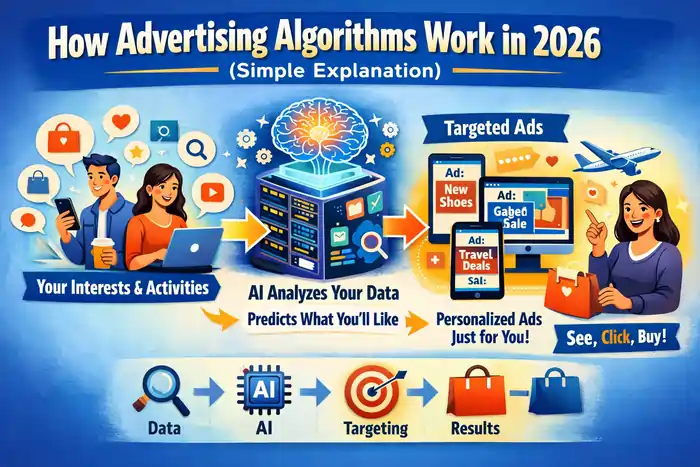
Advertising algorithms in 2026 rely on artificial intelligence (AI), machine learning, and large-scale behavioral data to determine which ads are shown to users. These systems analyze user behavior tracking, engagement signals, and audience segmentation to deliver highly personalized ads using automated processes such as real-time bidding (RTB) and programmatic ads. The objective is to maximize relevance, improve user experience, and increase advertiser performance while adapting to evolving privacy regulations (GDPR, data privacy) and platform policies.
Introduction: Why Advertising Feels So Accurate Today
In 2026, advertising no longer feels random. Many users notice that the ads they see closely match their interests, recent searches, or even things they were just thinking about. This perception has led to widespread curiosity about how advertising systems actually work.
The explanation is not as mysterious as it seems. Modern advertising is powered by data-driven ad targeting, advanced digital marketing algorithms, and increasingly sophisticated AI in digital marketing algorithms. These systems are designed to analyze patterns, predict behavior, and automate decisions at a scale that would be impossible for humans alone.
Rather than relying on guesswork, platforms now use predictive analytics in advertising and real-time ad decision systems to determine what content is most relevant to each individual user. This shift has transformed advertising from a broad, generic approach into a highly personalized experience.
Understanding how these systems work is important, not just for marketers, but for everyday users. It helps explain why ads appear the way they do, how personal data is used, and what level of control individuals have over their digital experience.
What Is an Advertising Algorithm?
An advertising algorithm is a system designed to automate decisions about ad delivery. It determines who should see an ad, when it should be shown, and which version of the ad is most likely to perform well.
At its core, an advertising algorithm combines automated advertising systems, machine learning ad optimization, and algorithmic marketing strategies to make these decisions in real time. It evaluates massive amounts of data, identifies patterns, and continuously improves its predictions.
These systems are part of a larger AI-driven advertising ecosystem, where every interaction contributes to future optimization. The more data the system processes, the more accurate its predictions become.
Advertising algorithms are not static. They evolve constantly, learning from user behavior, campaign performance, and changes in platform policies. This continuous improvement is what allows them to remain effective in a rapidly changing digital environment.
The Three Core Components of Advertising Algorithms
To understand how advertising algorithms function, it is helpful to break them down into three fundamental components: data collection, prediction, and delivery. Each plays a critical role in the overall system.
1. Data Collection: Building the Foundation
Everything begins with data. Without data, advertising algorithms would have no way to understand user preferences or predict behavior.
Data is collected through various methods, including cookies and tracking pixels, app interactions, browsing history, and platform engagement. These mechanisms enable user behavior tracking, allowing platforms to build detailed user profiles.
This process contributes to user profiling in online advertising, where individuals are categorized based on their actions, interests, and habits. Over time, these profiles become more refined, enabling more accurate targeting.
In addition, systems use audience segmentation using AI to group users into categories such as frequent shoppers, travel enthusiasts, or mobile gamers. This segmentation is essential for delivering relevant ads.
The distinction between behavioral targeting vs contextual targeting also becomes important at this stage. Behavioral targeting relies on historical data, while contextual targeting focuses on the content a user is currently viewing.
2. Prediction: The Intelligence Layer
Once data has been collected, the next step is prediction. This is where machine learning in digital advertising plays a central role.
Algorithms analyze past behavior to forecast future actions. Using predictive modeling in ad algorithms, the system estimates the likelihood that a user will click on an ad, engage with content, or complete a purchase.
This is a key component of data-driven ad targeting, where decisions are based on probabilities rather than assumptions. The system continuously refines its predictions as more data becomes available.
For example, if a user frequently searches for fitness-related products, the algorithm may predict a high likelihood of interest in sports apparel or health supplements. As a result, those ads are prioritized.
This predictive capability is what makes modern advertising systems so effective. It allows platforms to anticipate user needs and deliver ads that feel timely and relevant.
3. Delivery: Real-Time Execution
The final stage is ad delivery. This is where all the data and predictions are put into action.
When a user opens a website or app, a decision must be made instantly about which ad to display. This process is handled through real-time bidding (RTB) and programmatic ads, which automate the buying and placement of advertising space.
In a fraction of a second, multiple advertisers compete in an auction. The system evaluates bids, relevance, and predicted performance using real-time ad decision systems.
The winning ad is selected based on several factors, including bid amount, ad relevance score, and expected engagement. This ensures that the most effective ad is displayed.
This entire process is part of programmatic advertising, which has become the standard for digital ad delivery in 2026.
Step-by-Step Breakdown of How Advertising Algorithms Work
To simplify the process further, it can be broken down into a sequence of steps that occur every time a user interacts with digital content.
First, the user generates activity by browsing, searching, or engaging with content. These actions produce engagement signals, which are recorded by the system.
Next, this information is stored and analyzed using cookies and tracking pixels. The system builds a profile that reflects the user’s preferences and behavior.
The user is then categorized into segments through audience segmentation and sometimes matched with lookalike audiences, which are groups of users with similar characteristics.
Advertisers define their target audience using criteria such as demographics, interests, and behavior. This is part of targeted advertising, which ensures ads reach relevant users.
When the user accesses a platform, an auction takes place using models like cost per click (CPC) and cost per impression (CPM). The system evaluates each competing ad.
Finally, the algorithm selects the best ad based on performance indicators such as conversion tracking and ad relevance score, and displays it to the user.
Why Advertising Feels Highly Personalized
One of the most noticeable aspects of modern advertising is its level of personalization. This is largely due to the use of personalized ads, which are tailored to individual user profiles.
A major driver of this experience is retargeting ads. These ads are shown to users who have previously interacted with a product or website. For example, if someone views a product but does not purchase it, they may continue seeing ads for that product across different platforms.
This is made possible by cross-platform advertising algorithms, which track behavior across multiple devices and applications. As a result, the advertising experience feels consistent and persistent.
While this level of personalization can improve relevance, it also raises questions about privacy and data usage. Understanding the underlying mechanisms helps users make informed decisions about their online activity.
The Role of Machine Learning in Advertising
Machine learning is the driving force behind modern advertising systems. It enables continuous improvement and automation at scale.
Through machine learning ad optimization, systems analyze performance data and adjust campaigns in real time. This reduces the need for manual intervention and increases efficiency.
Machine learning also supports marketing automation, where processes such as bidding, targeting, and creative optimization are handled automatically. This allows advertisers to focus on strategy rather than execution.
The integration of machine learning into advertising has fundamentally changed how campaigns are managed and optimized. It has made advertising more dynamic, responsive, and data-driven.
Key Factors That Influence Ad Selection
Several factors determine which ad is ultimately shown to a user. These include:
- engagement signals, which indicate user interest
- ad relevance score, which measures how well an ad matches the audience
- conversion tracking, which evaluates past performance
- bid amount, which reflects advertiser investment
These elements work together within algorithmic marketing strategies to ensure that the most effective ad is selected.
Privacy and the Evolution of Advertising
Privacy has become a central issue in digital advertising. As awareness grows, regulations have been introduced to protect user data.
Modern systems are adapting by reducing reliance on traditional tracking methods and placing greater emphasis on contextual targeting. This approach focuses on the content being viewed rather than historical behavior.
Compliance with privacy regulations (GDPR, data privacy) is now a priority for platforms and advertisers alike. This has led to increased transparency and improved user controls.
Users now have more options to manage their data, adjust ad preferences, and limit tracking. This shift reflects a broader trend toward greater accountability in digital systems.
Ethical Considerations in Advertising Algorithms
As advertising algorithms become more advanced, ethical concerns have emerged. Issues such as algorithm bias affects advertising results and data misuse have sparked ongoing debate.
There is also a growing focus on the trade-offs between personalization and privacy in ads. While personalization improves user experience, it requires access to sensitive data.
Ensuring fairness, transparency, and accountability is essential for maintaining trust in these systems. Platforms are increasingly investing in solutions that address these challenges.
The Future of Advertising Algorithms
Looking ahead, advertising algorithms will continue to evolve. Advances in AI will lead to more sophisticated automated advertising systems and improved cross-platform advertising algorithms.
At the same time, privacy considerations will shape how data is collected and used. The balance between personalization and privacy will remain a key focus.
Future systems are likely to be more transparent, more efficient, and more aligned with user expectations. This evolution will define the next phase of digital advertising.
Conclusion
Advertising algorithms in 2026 are complex systems built on data, prediction, and automation. They rely on AI in digital marketing algorithms, predictive analytics in advertising, and real-time ad decision systems to deliver relevant and effective ads.
While these systems can seem overwhelming, understanding their basic structure makes them easier to navigate. It also empowers users to make informed decisions about their digital experience.
As technology continues to advance, staying informed will be essential for both users and professionals in the digital space.
Frequently Asked Questions
1. What is an advertising algorithm?
An advertising algorithm is a system that determines which ads are shown to users based on their behavior and preferences. It uses AI and data analysis to optimize ad delivery. These systems continuously learn and improve over time.
2. How do ads know what I like?
Ads rely on user behavior tracking such as browsing history and interactions. This data is analyzed to identify patterns and preferences. The system then delivers ads that align with those interests.
3. Are ads listening to me?
Advertising systems typically do not listen to conversations. Instead, they use predictive analytics in advertising based on online behavior. This creates the impression that ads are more intrusive than they actually are.
4. What is real-time bidding?
Real-time bidding (RTB) is an automated auction process where advertisers compete for ad space. It happens instantly when a page loads. The highest-value ad is selected in milliseconds.
5. What are cookies used for?
Cookies and tracking pixels collect data about user activity on websites. They help platforms understand behavior and preferences. This data improves ad targeting.
6. What is audience segmentation?
Audience segmentation divides users into groups based on shared characteristics. This allows advertisers to target specific audiences. It improves ad relevance and performance.
7. What are personalized ads?
Personalized ads are tailored to individual users based on their behavior and interests. They use collected data to improve relevance. This increases engagement and effectiveness.
8. What is retargeting?
Retargeting ads target users who have previously interacted with a product or website. They aim to encourage users to return and complete an action. This strategy improves conversion rates.
9. What is programmatic advertising?
Programmatic ads are bought and placed automatically using AI systems. This eliminates manual processes. It enables faster and more efficient ad delivery.
10. How do advertisers choose audiences?
Advertisers use data such as demographics, interests, and behavior. This is part of targeted advertising. It ensures ads reach relevant users.
11. What is CPC?
Cost per click (CPC) is a pricing model where advertisers pay for each click. It focuses on user engagement. It is commonly used in performance marketing.
12. What is CPM?
Cost per impression (CPM) measures the cost of 1,000 ad views. It focuses on visibility rather than clicks. It is often used for brand awareness.
13. What is ad relevance score?
The ad relevance score measures how well an ad matches its audience. Higher scores improve placement. It helps optimize performance.
14. What is conversion tracking?
Conversion tracking measures actions taken after interacting with an ad. This includes purchases or sign-ups. It helps evaluate campaign effectiveness.
15. What is behavioral targeting?
Behavioral targeting uses past user activity to deliver ads. It relies on user behavior tracking. This improves personalization.
16. What is contextual targeting?
Contextual targeting shows ads based on current content. It does not rely heavily on past data. It is more privacy-friendly.
17. Can I control my ads?
Yes, most platforms offer ad preference settings. Users can manage tracking and interests. This provides more control over ad experiences.
18. Are advertising algorithms safe?
Advertising algorithms are generally safe but raise privacy concerns. Regulations aim to protect users. Awareness helps maintain control.
19. Why do I see repeated ads?
Repeated ads are caused by retargeting ads and reinforcement strategies. Advertisers aim to increase recall. This improves conversion chances.
20. What is the future of advertising?
Advertising will become more AI-driven and privacy-focused. Systems will rely more on context than tracking. Transparency and user control will continue to improve.

