
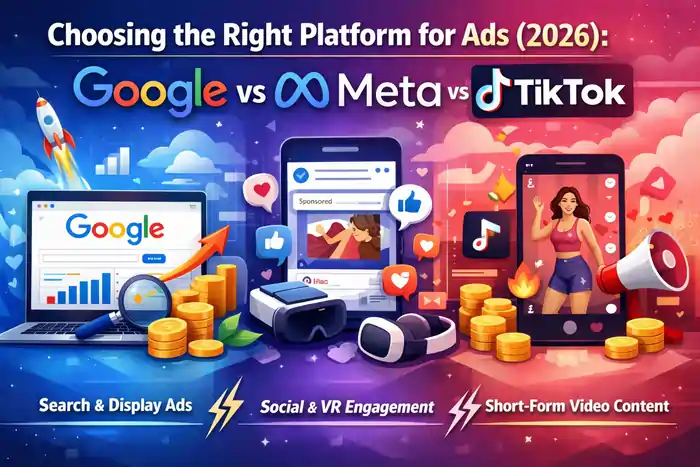
In 2026, choosing the right advertising platform depends on aligning your campaign with user intent and platform behavior. Google Ads captures high-intent searches where users are ready to take action, Meta Ads excels at targeting and nurturing interest, and TikTok drives discovery through AI-powered feeds. Each platform uses machine learning to optimize delivery based on engagement, relevance, and predicted outcomes. Success comes from matching your offer to the platform’s strengths—not from blindly following trends or spreading budget everywhere.
Introduction: The Platform Choice That Shapes Results
Most advertisers don’t fail because their ads are bad.
They fail because they’re running them in the wrong place.
It is a subtle mistake, but it has a massive impact. You can have great creatives, strong offers, and a solid budget—and still struggle—simply because the platform does not match the intent of your audience.
In 2026, advertising is no longer just about execution. It is about alignment.
Every platform operates differently. Users behave differently. Algorithms prioritize different signals. And most importantly, intent varies dramatically from one platform to another.
Choosing the right platform is not just a tactical decision. It is a strategic one that determines:
- how fast you get results
- how much you pay
- how scalable your campaigns become
When you get it right, everything becomes easier. When you get it wrong, everything becomes expensive.
The 2026 Advertising Landscape
Advertising today is shaped by artificial intelligence, automation, and real-time optimization systems.
Platforms are no longer passive channels. They are active decision-makers.
Google uses auction systems where ad visibility depends on a combination of bid, quality, and expected impact, as explained in its help article on how the Google Ads auction works.
Meta uses engagement-driven ranking systems that prioritize content based on predicted user interaction, which it outlines in its Transparency Center page on explaining ranking and feed systems.
TikTok relies heavily on AI-driven feeds that distribute content based on watch time and engagement patterns, as described in TikTok’s public creator and ads education materials.
This means something important:
You are no longer just running ads.
You are participating in algorithm-driven ecosystems.
And each ecosystem rewards different behaviors.
Platform Intent: The Foundation of Everything
If you understand one concept, everything else becomes clearer:
Different platforms serve different types of intent.
High Intent (Search-Based)
This is where users actively look for solutions.
They type queries because they already have a need.
Example:
- “buy gaming laptop online”
These users are close to conversion.
Mid Intent (Consideration-Based)
These users are exploring.
They are not ready to buy yet, but they are evaluating options.
Example:
- watching reviews or comparing products
Low Intent (Discovery-Based)
These users are not searching.
They are browsing, scrolling, and consuming content.
Example:
- scrolling TikTok or Instagram
Why This Changes Everything
If you run a discovery-style ad on a high-intent platform, it underperforms.
If you run a high-intent campaign on a discovery platform, it struggles.
Performance is not random. It is often a mismatch between intent and platform.
Google Ads: Capturing Demand at the Right Moment
Google is the most intent-driven platform.
It works because users come with a purpose.
Google explains in its public guide on how Search works that it prioritizes relevance, usefulness, and intent when ranking results and ads together in the ecosystem.
Why Google Works So Well
When someone searches, they are telling you exactly what they want.
There is no guessing.
There is no need to convince them to be interested.
Your job is simply to match their intent.
Strengths of Google Ads
Google excels in situations where demand already exists.
It provides:
- high conversion potential
- direct response performance
- measurable ROI
- clear keyword targeting
This makes it one of the most reliable platforms for businesses focused on sales, lead generation, and high-intent actions.
But There Is a Catch
Google does not create demand.
If people are not searching for your product or service, Google cannot generate interest.
It can only capture existing demand.
Meta Ads: Turning Attention Into Interest
Meta operates in a completely different environment.
Users are not searching.
They are browsing.
What Makes Meta Powerful
Meta allows you to target specific audiences based on:
- demographics
- interests
- behavior
- past interactions
Its system then uses engagement signals to decide which content to show more often.
Meta explains how engagement and relationships influence visibility in its overview of how ranking and personalization work.
Why This Matters
Meta is not about capturing demand.
It is about creating it.
You introduce your product to someone who may not have been actively looking—but becomes interested after seeing your message.
Strengths of Meta Ads
Meta is strong in:
- audience targeting
- brand building
- visual storytelling
- retargeting campaigns
It allows you to guide users from awareness to consideration and nurture them across multiple touchpoints.
The Limitation
Meta requires strong creative execution.
If your content does not capture attention quickly in the feed, the algorithm will not push it and your costs will feel high relative to results.
TikTok Ads: The Discovery Engine
TikTok represents the most aggressive shift toward AI-driven distribution.
Unlike traditional platforms, it does not rely heavily on followers.
It relies on performance.
How TikTok Works
TikTok evaluates content based on:
- watch time
- completion rate
- engagement (likes, comments, shares, saves)
- replays and re-watches
If your content performs well on these metrics, it gets distributed further into the For You feed.
Why TikTok Is Unique
TikTok is not just a social platform.
It is a discovery engine.
It introduces users to content and products they did not know they wanted.
Strengths of TikTok Ads
TikTok excels in:
- rapid reach
- viral potential
- content discovery
- younger and trend-driven audiences
The Trade-Off
TikTok requires:
- strong hooks in the first seconds
- engaging storytelling
- native, platform-style content
Highly polished, traditional ad-looking creatives often perform worse than authentic, organic-feeling videos.
Direct Comparison: Understanding the Differences
The biggest mistake advertisers make is treating these platforms as interchangeable.
They are not.
Intent Comparison
- Google captures action.
- Meta builds interest.
- TikTok drives discovery.
User Mindset
- On Google, users are problem-focused.
- On Meta, users are passive but targetable.
- On TikTok, users are exploratory and entertainment-driven.
Performance Expectations
- Google delivers immediate, intent-driven results.
- Meta builds momentum and warms up audiences.
- TikTok creates spikes, discovery, and rapid awareness.
The Role of AI in Platform Performance
All three platforms rely heavily on machine learning.
They analyze:
- user behavior
- engagement patterns
- content relevance
- predicted outcomes
Google highlights how AI enhances evaluation and ranking systems in its blog on Search guidance for AI-generated content, while still prioritizing helpful, people-first experiences.
What this means for advertisers:
You cannot rely on:
- budget alone
- targeting alone
- frequency alone
You must optimize for:
- relevance
- engagement
- experience
Why Trends Mislead Advertisers
It is easy to fall into trend-based thinking.
You hear:
- “TikTok is the future”
- “Facebook is dead”
- “Google is too expensive”
But these statements ignore context.
A platform is not good or bad.
It is either aligned or misaligned with your audience and offer.
A Smarter Strategy: Multi-Platform Alignment
The most effective advertisers do not choose one platform.
They combine them.
Example Funnel
- TikTok introduces the product and generates curiosity.
- Meta nurtures the interest with retargeting and storytelling.
- Google captures the conversion when the user actively searches later.
Why This Works
Each platform plays a role in the customer journey.
Together, they create a system where awareness, consideration, and conversion are supported across touchpoints.
The Economics of Platform Choice
Spending more does not guarantee better results.
Research from McKinsey on digital transformation and data-driven performance shows that companies using data-led strategies consistently outperform those relying on brute-force spend.
In Advertising Terms
- Efficiency beats scale.
- Better alignment beats bigger budgets.
Common Mistakes That Kill Performance
Many advertisers struggle because they:
- choose platforms based on hype
- ignore user intent
- reuse the same creatives everywhere
- fail to test and iterate per platform
Each of these reduces effectiveness and drives up costs.
How to Choose the Right Platform (Practical Framework)
Start with intent.
Then define your goal.
Then match the platform.
Finally, test and optimize.
Questions to Ask
- Are users searching or browsing?
- Is your goal awareness, lead generation, or direct conversion?
- Do you have strong creatives for visual and social platforms?
- Can you support the platform’s native format (short video, static, search)?
Platform Optimization Strategies
Focus on:
- keyword intent
- landing page relevance
- Quality Score and ad strength
Meta
Focus on:
- creative testing and iteration
- audience segmentation and retargeting
- engagement signals and thumb-stopping visuals
TikTok
Focus on:
- strong hooks in the first seconds
- storytelling and pattern interrupts
- retention, watch time, and save or share-worthiness
The Bigger Insight: Platforms Are Systems
Each platform is a system that rewards:
- relevance
- engagement
- performance
If you understand the system, you gain leverage.
If you ignore it, you lose efficiency.
Final Perspective
In 2026, advertising is not about being everywhere.
It is about being in the right place with the right message.
Bottom Line
Choose platforms based on:
- intent
- audience
- goal
Final Insight
The advertisers who win are not the ones who spend the most.
They are the ones who understand how each platform works—and align their strategy accordingly.
Because in modern advertising, alignment beats trends every time.

