
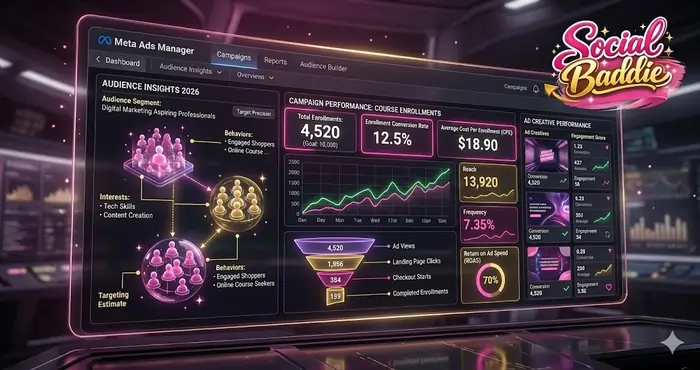
In the high-stakes world of digital education, the gap between a “starving instructor” and a “multi-million dollar educator” is almost always the quality of their paid acquisition system. While organic content on YouTube or TikTok can build a community, Meta ads for selling online courses remain the most predictable and scalable engine for generating consistent revenue in 2026.
As we explore in our Growth Lab, successful course creators do not view advertising as an expense; they view it as a precision-engineered customer acquisition machine. This comprehensive guide will dissect the technical, psychological, and strategic layers required to master Meta ads for selling online courses, moving beyond simple “boosted posts” into the realm of advanced performance marketing.
The Proactive Nature of Meta Ads for Selling Online Courses
Unlike Google Search Ads, which rely on a user already knowing they have a problem and searching for a solution, Meta ads for selling online courses allow you to create demand. By leveraging the visual and behavioral data of Facebook and Instagram, you can place your curriculum in front of people who didn’t even know they were ready to learn a new skill.
The Psychological Shift
For local businesses or e-commerce products, the decision is often tactical. For education, the decision is emotional and aspirational. People don’t buy courses; they buy the “future version” of themselves. Therefore, your strategy for Meta ads for selling online courses must focus on the transformation, not just the syllabus.
Whether you are targeting career switchers or hobbyists, your Social Baddie strategy must lead with the “After State”—the success your students will achieve once they finish your program.

Funnel Architecture: Moving From “Cold” to “Enrolled”
The most common mistake in Meta ads for selling online courses is sending cold traffic directly to a high-ticket sales page. This is the fastest way to burn your budget. Instead, we use a multi-stage funnel designed to build trust at every touchpoint.
Stage 1: The Top-of-Funnel (TOFU) Awareness Layer
At this stage, your Meta ads for selling online courses should focus on high-level engagement.
- Goal: Broad awareness and “pixel seasoning.”
- Format: Short-form video (Reels) that solve one tiny problem for free.
- Metric: Video play rate and Click-Through Rate (CTR).
Stage 2: The Middle-of-Funnel (MOFU) Lead Capture Layer
This is where the magic happens. You offer a “Lead Magnet”—a PDF, a webinar, or a free mini-lesson—in exchange for an email address. This step is a cornerstone of our PPC Lab Notes. By using Meta Lead Forms, you can capture student data without them ever leaving the app, significantly lowering your $CPA$ (Cost Per Acquisition).
Stage 3: The Bottom-of-Funnel (BOFU) Conversion Layer
Now that the prospect knows you, likes you, and has consumed your free value, your Meta ads for selling online courses shift toward the hard sell. Use student testimonials, case studies, and urgency-based offers to drive the final purchase.
Mastering the Meta Algorithm: Learning and Scaling
To succeed with Meta ads for selling online courses, you must speak the algorithm’s language. The Meta AI is designed to find users who are likely to complete your desired action, but it needs data to do so.
The Learning Phase
Every time you launch a new ad set, it enters the Learning Phase. During this time, Meta is testing different pockets of your audience. Meta ads for selling online courses often fail because creators get impatient and change their budget or creative before the algorithm has finished learning.
- Rule: Leave your ads alone until they reach 50 conversion events in a 7-day period.
ABO vs. CBO: Which One Wins?
- ABO (Ad Set Budget Optimization): Use this for testing. It forces Meta to spend a specific amount on each “test” audience.
- CBO (Campaign Budget Optimization): Use this for scaling. Once you’ve identified winning audiences, let Meta’s AI distribute your budget to the highest performers in real-time.
Advanced Audience Targeting and Segmentation
In 2026, targeting is less about “hacking” interests and more about “feeding” the algorithm the right signals. For Meta ads for selling online courses, we utilize a three-pillar targeting strategy.
Pillar 1: Interest-Based Layering
Don’t just target “Online Learning.” Combine a broad interest with a specific one. For example:
Interest: Digital Marketing + Interest: Coursera or Udemy.
This ensures you are reaching people who are already prone to buying digital education.
Pillar 2: Lookalike Audiences (LAL)
This is the “secret sauce” for Meta ads for selling online courses. Once you have 100+ purchasers, you can create a 1% Lookalike Audience. Meta will then find people who share the exact behavioral traits of your current students.
Pillar 3: The Retargeting Machine
If someone visits your checkout page but doesn’t buy, they are your highest-value prospect. Use Meta ads for selling online courses to show them a 15% discount code or a “Frequently Asked Questions” video to remove their final barriers to purchase.
Creative Strategy: The Performance-First Approach
In the world of Meta ads for selling online courses, the creative (the video or image) is your most important lever.
The “Problem-Solution-Proof” Formula
- The Hook (First 3 Seconds): Address the pain point immediately. “Struggling to get your first 100 students?”
- The Solution: Introduce your course as the bridge between their current state and their dream state.
- The Proof: Show a screenshot of a student result or a video testimonial.
- The CTA: Tell them exactly what to do next. “Enroll today via the link below.”
Creative Sequencing
Don’t show the same ad over and over. Use Meta ads for selling online courses to tell a story.
- Day 1-3: Introduce yourself (Authority).
- Day 4-7: Show the curriculum (Utility).
- Day 8-10: Show student success (Proof).
- Day 11-14: Limited time bonus (Urgency).
Technical Excellence: CAPI and Server-Side Tracking
Post-iOS 14, browser-based tracking is no longer sufficient. To scale Meta ads for selling online courses, you must implement the Meta Conversions API (CAPI).
Why CAPI Matters for Course Creators
Standard pixels can be blocked by ad-blockers or browser privacy settings. CAPI sends event data directly from your server (e.g., WordPress or Teachable) to Meta. This ensures:
- Accurate Attribution: You know exactly which ad led to which student.
- Better Optimization: Meta’s AI receives more data points, allowing it to find students faster.
- Lower CPMs: Better data lead to better relevance scores, which lowers your advertising costs.
Deduplication is key here. Ensure your Meta Pixel and CAPI are sending the same unique event IDs to avoid double-counting sales.
Landing Page Optimization for Course Sales
Your Meta ads for selling online courses can be perfect, but if your landing page is weak, your $ROAS$ will suffer. At Social Baddie, we focus on “High-Intent” landing pages.
The Anatomy of a High-Converting Course Page
- The Hero Section: A headline that repeats the promise of your ad.
- Social Proof: Logos of where you’ve been featured or “Student Favorite” badges.
- The Curriculum: A clear, visual breakdown of what’s inside the “member area.”
- Risk Reversal: A 30-day money-back guarantee. This is the #1 way to increase conversion rates for Meta ads for selling online courses.
- Accessibility: Ensure your page is mobile-optimized and has high-contrast text for inclusivity.
Budgeting and Scaling Without Breaking the Algorithm
Scaling Meta ads for selling online courses is an art. If you increase your budget from $100 to $1,000 overnight, you will break the learning phase and your performance will crash.
Vertical Scaling
Increase your budget by 20% every 48–72 hours. This allows the Meta algorithm to adjust without sending your ad sets back into the “re-learning” state.
Horizontal Scaling
Instead of just spending more on one ad, create a new ad set with a different audience or a different creative angle. This allows your Meta ads for selling online courses to reach new pockets of users without competing with your own ads (avoiding “Audience Overlap”).
Common Pitfalls in Meta Ads for Selling Online Courses
Even seasoned marketers make mistakes. Here is what to avoid:
- Ignoring Creative Fatigue: If your CTR drops and your CPM rises, your audience is tired of your ad. Swap it out!
- Narrow Targeting: In 2026, “Broad” targeting often outperforms interest-based targeting because Meta’s AI is now smart enough to find your students based on the content of your ad.
- No Retargeting: 90% of your profit in Meta ads for selling online courses lives in the retargeting layer.
- Poor Follow-Up: If you capture a lead, you must have an automated email sequence to “nurture” them toward the final sale.
Semantic SEO and GEO: Preparing Your Content for 2026
For your Meta ads for selling online courses guide to rank, it must satisfy Generative Engine Optimization. This means using LSI keywords naturally throughout the text.
Secondary Keywords to Include:
- Facebook ads for course creators
- Webinar funnel ads
- Digital course enrollment strategy
- Paid traffic for online education
- Student result proof
- Low ticket vs high ticket course ads
- Online learning conversion system
By clustering these terms, you signal to AI-driven search engines that this is an “Expert” piece of content worthy of being featured in AI overviews.
Conclusion: Building Your Digital Growth System
Success with Meta ads for selling online courses is not about “luck”—it is about building a robust, data-backed system. By focusing on full-funnel architecture, server-side tracking, and creative excellence, you move away from being a “marketer” and become a “growth architect.”
At Social Baddie, we believe that every expert deserves an audience. Whether you are scaling a low-ticket hobby course or a high-ticket certification program, these frameworks will ensure your ad spend turns into measurable business growth.
For more insights on media buying and conversion optimization, explore our latest PPC Lab Notes or dive into the full resources available at The Growth Lab. Let’s turn your expertise into a scalable enrollment engine.

