
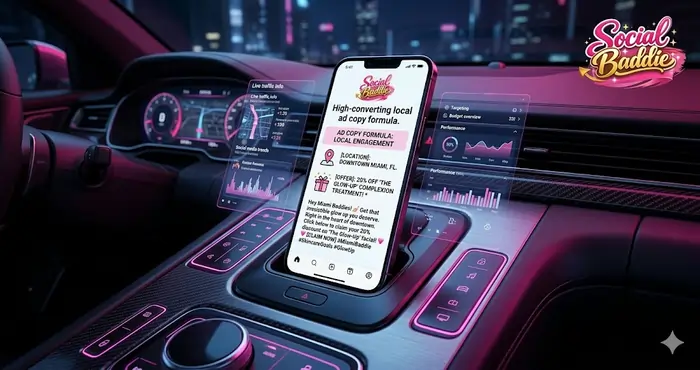
In the current digital landscape, the phrase “build it and they will come” is officially dead. For local stores, dental clinics, real estate agencies, and service providers, relying solely on foot traffic or word-of-mouth is a high-risk strategy. Consumer behavior has undergone a fundamental shift; today, the customer journey for a local service almost always begins on a smartphone screen.
Whether someone is looking for the best brunch spot in Tagum City or an emergency plumber in downtown London, they turn to Facebook and Instagram to validate a business’s credibility. This is where Meta Ads for Local Businesses becomes the most powerful tool in your digital arsenal. Unlike broad national campaigns that “spray and pray,” local Meta advertising allows for surgical precision—placing your offer in front of the right person, at the right time, within the right radius of your front door.
This guide, part of our extensive Growth Lab repository, will break down every technical and strategic layer of running high-performance local campaigns.
The Psychology of Local Intent: Why Local Ads Convert Higher
Before clicking a single button in Meta Ads Manager, you must understand the “Why.” Local advertising isn’t just about geography; it’s about proximity-based trust.
When a user sees an ad for a national brand, they see a corporation. When they see an ad for a business 3 kilometers away, they see a neighbor. This proximity creates an immediate “low-friction” psychological state. The user knows that taking action—whether it’s booking a consultation or visiting a store—is convenient.
The “Immediate Solution” Framework
Local intent is usually driven by one of three things:
- Urgency: “My tooth hurts now.” (Dental Clinics)
- Routine: “I need a gym near my work.” (Fitness Centers)
- Indulgence: “I want a great meal tonight.” (Restaurants)
By aligning your Meta Ads for Local Businesses strategy with these intent drivers, you move from “interruptive marketing” to “solution-based marketing.” For a deeper look at intent-based scaling, see our PPC Lab Notes.
Technical Foundations: Meta Business Suite vs. Ads Manager
Many local business owners make the mistake of using the “Boost Post” button. While convenient, it is the “diet” version of advertising. To truly scale and achieve a high $ROAS$ (Return on Ad Spend), you must operate within the full Meta Ads Manager ecosystem.
The Hierarchy of Your Account
- Business Account: The umbrella that owns your pages and ad accounts.
- Ad Account: Where the billing and campaigns live.
- Meta Pixel & Conversions API (CAPI): Critical for tracking. Even for local businesses, knowing who visited your website after seeing an ad is the key to retargeting success.
Strategic Objectives: Choosing Your North Star
One of the biggest reasons for wasted spend in Meta Ads for Local Businesses is selecting the wrong objective. Meta’s AI optimizes for the action you tell it to find.
The “Social Baddie” Objective Breakdown
| Objective | Best For | Technical Insight |
| Awareness | New store openings or rebranding. | Optimized for reach, not necessarily action. |
| Traffic | Driving users to a menu, price list, or “Contact Us” page. | Best for businesses with high-quality website content. |
| Leads | Service businesses (Real Estate, Clinics, B2B). | Uses Instant Forms to capture data without leaving Facebook. |
| Messages | High-touch sales (Salons, Tutors, Consultants). | Initiates a conversation in Messenger, [suspicious link removed], or WhatsApp. |
Pro-Tip: If you are a beginner, start with Messages. Local customers often have one or two “barrier-to-entry” questions. Answering them in real-time is the fastest way to secure a booking.
Masterclass in Geographic Targeting (The Radius Strategy)
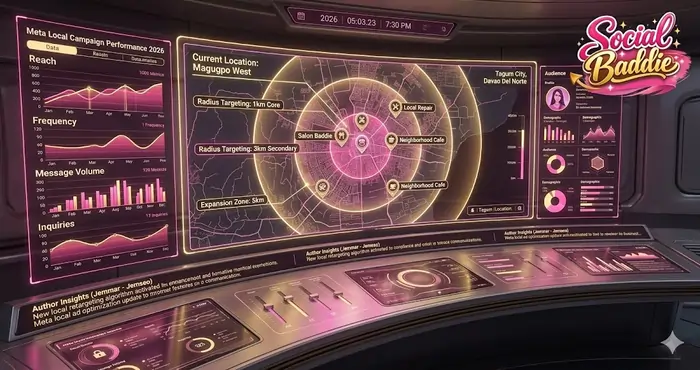
The heart of Meta Ads for Local Businesses is the Radius Targeting feature. However, “setting it and forgetting it” is where most marketers fail.
Layer 1: The Residents vs. Visitors Filter
Meta gives you four options for location targeting. For local growth, you must choose:
- “People living in this location”: This excludes tourists and commuters who may see your ad but will never return for a second visit. This is essential for building a loyal, local customer base.
Layer 2: The “Service Area” vs. “Brand Area”
- The 3km – 5km “Core”: This is your high-intent zone. People here are most likely to become “regulars.”
- The 10km – 20km “Expansion”: Only target this if your offer is unique enough to justify the travel time. A specialized surgical clinic can target 20km; a coffee shop should not.
[Image showing a heat map of conversion probability based on distance from the business location]
Audience Layering: Finding Your Ideal Customer
While location is the primary filter, Meta Ads for Local Businesses allows you to layer interests and behaviors to increase $CPA$ (Cost Per Acquisition) efficiency.
Demographic Layering
- Age/Gender: If you run a Women’s Boutique, don’t waste impressions on men unless it’s a holiday gifting season.
- Life Events: Target “Recently Moved” for home repair services or “Upcoming Anniversary” for high-end restaurants.
Interest-Based Layering
- Competitor Interests: You can often target people interested in “large chain” competitors to offer them a local, boutique alternative.
- Behavioral Targeting: Target “Engaged Shoppers” to find people who have a history of clicking “Shop Now” buttons.
Ad Creative: The “Local Trust” Factor
In local advertising, high-gloss, corporate creative often performs worse than authentic, “hand-held” content. People buy from people they recognize.
The Three Pillars of Local Creative
- Recognition: Show the storefront or a recognizable local landmark. This stops the scroll because the user realizes, “Hey, that’s near me.”
- Faces: Show the owner or the staff. This humanizes the brand and lowers the psychological barrier to entry.
- The Offer: Use the Location + Offer + Action formula.
Format Selection
- Video Ads: A 15-second “Walkthrough” of your clinic or shop.
- Carousel Ads: Showcase different services (e.g., a spa showing massage, facials, and nail care in one ad).
- Collection Ads: Perfect for local retail stores to show a “mini-catalog” within the Facebook app.
Writing Ad Copy That Converts: The “Social Baddie” Method
Your copy should read like a conversation, not a pitch. As we discuss on the Social Baddie homepage, performance marketing is about clarity over cleverness.
The Anatomy of a Local Ad
- The Hook: Acknowledge the location. “Calling all [City Name] residents!”
- The Body: State the problem and your local solution. “Tired of driving an hour for a quality haircut? We’re right around the corner on [Street Name].”
- The Social Proof: Mention local reviews. “Voted #1 in [City] for three years running!”
- The CTA (Call to Action): Be specific. “Tap ‘Send Message’ to book your slot for this Saturday.”
Budgeting and Bidding: Playing the Long Game
A common fear for local owners is the “money pit” myth. Meta Ads for Local Businesses is actually safer than traditional media because of the data feedback loop.
The Testing Phase ($Phase 1$)
Start with a modest daily budget—enough to get at least 50 “optimization events” (clicks or messages) per week.
- Formula: If your goal is a message, and you expect a message to cost $2.00, your daily budget should be at least $15.00 ($2.00 \times 7 \text{ days} = $14.00$).
The Scaling Phase ($Phase 2$)
Once you find a “winning” ad (one with a high CTR and low CPC), increase the budget by 20% every 3–4 days. Never double the budget overnight, as this will reset the Learning Phase.
Retargeting: The Secret to Local Dominance
Most local customers won’t buy the first time they see you. They need 7–10 “touchpoints.”
The Local Retargeting Funnel
- Cold Audience (Top of Funnel): Introduce the brand with a video ad.
- Warm Audience (Middle of Funnel): Retarget anyone who watched 50% of that video with a “Limited Time Offer” or “Client Testimonial.”
- Hot Audience (Bottom of Funnel): Retarget people who visited your website but didn’t book. Offer a “First-Time Customer Discount.”
This structure is what we call the Digital Growth System at Social Baddie.
Lead Management: The “Speed to Lead” Rule
If you are running Click-to-Message or Lead Form ads, your work doesn’t end when the ad is clicked.
- The 5-Minute Rule: If you respond to a local lead within 5 minutes, your chance of conversion is 9x higher than if you wait an hour.
- Automated Responses: Use Messenger Automations to answer common questions (Hours, Location, Pricing) even while you sleep.
Technical Optimization: GEO and Accessibility
For your content to rank and be shared effectively, it needs to follow modern web standards. This is where Adscrew PH (my agency) focuses on the intersection of SEO and Paid Ads.
Semantic Markup for Local Ads
When driving traffic to a landing page, ensure your site uses LocalBusiness Schema. This helps Google and AI engines understand:
- Your physical address.
- Your opening hours.
- Your price range.
Accessibility Check
Ensure your ad videos have Captions. Many users scroll through Facebook with the sound off. If they can’t read what you’re saying, they’ll keep scrolling.
FAQ: Everything You Need to Know About Meta Ads for Local Businesses
Q: Are Meta Ads better than Google Ads for local businesses?
A: They serve different purposes. Google is for “Active Demand” (people searching for you). Meta is for “Creating Demand” (showing people you exist before they even search). For most local brands, a mix of both is ideal, but Meta is often cheaper for brand building.
Q: How much should I spend to start?
A: You can start with as little as $5–$10 per day. The key is consistency, not the size of the initial check.
Q: Can I target specific neighborhoods?
A: Yes. You can drop a “pin” on a specific neighborhood and set a 1km radius to ensure you are only reaching the exact streets you want to serve.
Q: Does Instagram work for local services?
A: Absolutely. Instagram is highly visual and works exceptionally well for lifestyle-based local businesses like gyms, salons, cafes, and real estate.
Case Study: The “Salon Growth” Blueprint
Imagine a local salon in a competitive district. By using the strategies in this guide, they implemented the following:
- Week 1: A “Behind the Scenes” video ad targeting a 5km radius.
- Week 2: A Carousel ad showing “Before & After” transformations to people who engaged with the first video.
- Week 3: A “New Client 20% Off” coupon delivered via Message Ads.
- Result: A 40% increase in new bookings within 30 days and a $CPA$ that was half the price of their previous “Boosted Posts.”
Final Expert Insight: The Power of Local Relevance
As someone who has spent over 9 years in the performance marketing trenches, I can tell you this: The most relevant ad always wins. You don’t need the biggest budget in your city to win at Meta Ads for Local Businesses. You need to be the most helpful, the most present, and the most authentic. When you combine Meta’s powerful Audience Network with a deep understanding of your local neighbor’s needs, you create a customer acquisition machine that works 24/7.
Stop waiting for people to “find” you. Go to where they already are—on their phones, in their feeds, and in their local community.
To start building your custom growth system today, explore the resources at Social Baddie or dive into our latest PPC strategies. Let’s turn that local attention into measurable business growth.

