

Overview
Understanding when to kill, pause, or scale Meta ad is the most critical decision-making process in modern performance marketing. For many beginners, opening the Meta Ads Manager feels like stepping into a cockpit without a flight manual. You are met with a dizzying array of numbers, but very few of them tell you exactly what to do with your money. Should you give that underperforming ad another day? Is it time to double the budget on your top performer? Should you pull the plug entirely?
As a Digital Marketing Specialist with over 9 years of experience managing high-ticket campaigns from my base in Tagum City, Davao Del Norte, I have learned that profitability is not found in the creative alone; it is found in the discipline of your decisions. In 2026, the Meta Lattice AI handles the delivery, but you—the media buyer—handle the capital. This guide is your definitive 10/10 manual on when to kill, pause, or scale Meta ad, providing you with a mathematical framework to remove emotion from your advertising and replace it with pure, scalable ROI through The Growth Lab.
Chapter 1: The Psychology of Media Buying Decisions
Before we dive into the spreadsheets and the “Vital Five” metrics, we must address the human element. The reason most beginners struggle with when to kill, pause, or scale Meta ad is not a lack of data; it is a lack of patience.
The Panic Factor
In the early days of a campaign, performance fluctuates wildly. One day you might have a $2 lead, and the next day it spikes to $15. If you panic and kill the ad on Tuesday because of Monday’s results, you are effectively “blinding” the algorithm. The Meta algorithm is a learning machine. Every time you make a change, you reset that machine learning process. To be a professional, you must move away from the “Today” view in your dashboard and start looking at 7-day and 14-day rolling averages at Social Baddie.
The Scaling Fear
On the opposite end of the spectrum is the fear of success. Many advertisers have a winning ad but are afraid to increase the budget because they worry the performance will break. Knowing when to kill, pause, or scale Meta ad means knowing when to be aggressive. If you have a high ROAS (Return on Ad Spend) and you are not scaling, you are leaving money on the table for your competitors to take. In 2026, those who hesitate are outbid by those who trust their data.
Chapter 2: The “Vital Five” Metrics That Dictate Your Choice
To decide when to kill, pause, or scale Meta ad, you must customize your Ads Manager columns to show the only five metrics that truly impact your business in the Philippines or abroad.
1. Cost Per Result (CPA)
This is your primary anchor. If your goal is to generate leads for a real estate project in Magugpo West and your target CPA (Cost Per Action) is 200 pesos, this metric tells you everything you need to know. Any decision on when to kill, pause, or scale Meta ad begins here. If your CPA is below your target, you are in the “Green Zone.”
2. Return on Ad Spend (ROAS)
If you are in e-commerce, ROAS is your oxygen. It measures the revenue generated for every dollar spent. You must know your “break-even point” before you spend a single cent.
$$\text{Break-even ROAS} = \frac{1}{\text{Profit Margin Percentage}}$$
If your margin is 25%, your break-even is 4.0. If you are at 5.0, you are ready for the scaling discussion.
3. Link Click-Through Rate (CTR)
This measures creative resonance. If your CTR is below 1%, your message is likely not landing. When we study when to kill, pause, or scale Meta ad, we use CTR to diagnose “Creative Fatigue“—the point where your audience gets tired of seeing the same image or video. A high CTR with a high CPA usually indicates a landing page problem.
4. Hook Rate (3-Second Video View / Impressions)
For the 2026 video-first landscape, this is non-negotiable. If your Hook Rate is low, you don’t need to kill the campaign; you just need to change the first three seconds of the video using ad creative best practices. Your “Hook” is the gatekeeper of your entire funnel.
5. Conversion Rate (CVR)
This measures the bridge between Meta and your website. If CTR is high but CVR (Conversion Rate) is low, your ad is a “tease” that the landing page fails to deliver on. This is a crucial distinction when deciding when to kill, pause, or scale Meta ad.
Knowledge Graph: Metric Interpretation Matrix
| Metric Signal | Root Problem | Recommended Strategic Action |
| High CTR / Low CVR | Landing Page Friction | Pause & Audit Website User Experience (UX) |
| Low CTR / High CPM | Audience/Creative Mismatch | Kill Creative & Launch New Hooks |
| Stable CPA / High ROAS | Profitable Alignment | Scale Vertically by 20% |
Chapter 3: When to Kill a Meta Ad (The Termination Protocol)
Knowing when to kill, pause, or scale Meta ad requires a “Termination Protocol.” Killing an ad is permanent. It means the asset has failed the statistical test of profitability.
The 3x CPA Rule
This is the golden rule used at Adscrew PH. If an ad has spent 3 times your target CPA without a single conversion, you must kill it. There is no “giving it more time.” If your target CPA is $10 and you have spent $30 with 0 results, the market has spoken. Kill it. Beginners often hold on because they “like” the ad—professionals kill it because the data is cold.
The Frequency Ceiling
In smaller markets like Davao Del Norte, audience saturation happens quickly. If your ad frequency hits 3.0 or 4.0 and your CPA starts climbing alongside it, you are witnessing “Creative Fatigue.” This is exactly when to kill, pause, or scale Meta ad—specifically, you kill the fatigued ad and introduce a fresh visual concept to the same audience.
Negative ROAS Trends
If an ad was a winner last month but has shown a steady 10% decline in ROAS every week for the last three weeks, it is likely reaching the end of its lifecycle. Do not wait for it to become unprofitable. Kill it while you are still in the green and transition that budget to your next test in your PPC lab notes.
Chapter 4: When to Pause a Meta Ad (The Tactical Stop)
Pausing is often misunderstood. It is a temporary measure used when the data is inconclusive or when external factors are at play. Mastering when to kill, pause, or scale Meta ad involves knowing when to hit “pause” to investigate.
The Technical Glitch
If you see a sudden drop to 0% conversion rate but your traffic is still high, pause the campaign immediately. 99% of the time, this is a Meta Pixel error, a broken landing page, or a website server issue. Pause the ad, fix the tech, and resume.
The Weekend Variance
In professional Lead Generation media buying, Sunday performance is often abysmal. If your data over 30 days shows that Sundays consistently return a 0.5 ROAS while weekdays return a 3.0, you should pause your ads on Sundays. This is a strategic application of when to kill, pause, or scale Meta ad based on consumer behavior cycles.
The Inventory/Seasonal Reset
If you are running a Valentine’s Day promotion, and it is now February 15th, you don’t necessarily need to “kill” the ad set structure, but you must pause the creative. This allows you to retain the audience data within that ad set for your next seasonal promotion in The Growth Lab. Similarly, if your stock is depleted, pause the ads to avoid generating unfulfillable orders.
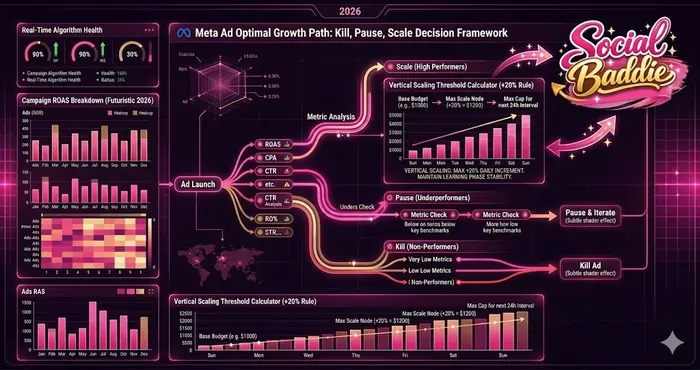
Chapter 5: When to Scale Meta Ad (The Growth Engine)
This is the most critical part of the framework. Scaling is how you turn a $100/day profit into a $1,000/day profit. Knowing when to kill, pause, or scale Meta ad is what allows for exponential business growth.
Vertical Scaling: The Stability Method
Vertical scaling is the act of increasing the budget on an existing ad set. In 2026, the Meta Lattice AI is sensitive. If you increase the budget by 50% in one day, you will “shock” the ad auction algorithm, and your CPA will spike.
- The Rule: Increase the budget by 20% every 48 to 72 hours.
- The Trigger: Do this only if the ROAS has been stable or improving over the last 7 days.
Horizontal Scaling: The Market Expansion
If your ad is a winner in Tagum City, it is time to take it to the next level. Horizontal scaling involves duplicating the winning creative into new audiences or geographic regions.
- The Rule: Duplicate the winning ad into a Broad audience (No Interests) or a 1% Lookalike Audience of your buyers.
- The Trigger: Use this when your vertical scale hits a “diminishing returns” wall where increasing the budget no longer improves total profit.
Chapter 6: The Learning Phase and Data Aggregation
You cannot effectively decide when to kill, pause, or scale Meta ad if your campaign is stuck in “Learning Limited.” The Meta algorithm needs 50 conversion events per week to exit the learning phase.
Aggregating for Decisions
If you have 10 ad sets each spending $5 a day, none of them will ever reach 50 conversions. You will be stuck guessing when to kill, pause, or scale Meta ad because the data is too fragmented.
- Professional Tip: Consolidate your budget. Instead of 10 ad sets, run 2 ad sets with $25 each. This forces the data to aggregate, giving you clear “Scale” or “Kill” signals within days instead of weeks at Social Baddie.
Chapter 7: Geographic Nuances in the Philippines market
Managing ads from Magugpo West provides a unique look at localized data. When deciding when to kill, pause, or scale Meta ad in the Philippine market, consider these factors:
The “COD” Effect
In the Philippines, Cash on Delivery is king. If your ROAS is low, check your payment options. Sometimes the decision on when to kill, pause, or scale Meta ad is actually a decision on whether your checkout process matches local trust signals. If trust is low, even the best ad will fail.
Regional CPA Variance
A lead in Makati will almost always cost more than a lead in Tagum City due to auction competition. When analyzing when to kill, pause, or scale Meta ad, use the “Breakdown” report in Ads Manager to see performance by region. You might find that while the overall campaign looks “Average,” Davao is a “Scale” candidate while Manila is a “Kill” candidate. This granular reading prevents you from killing a campaign that is actually winning in certain provinces.
Chapter 8: Reading Video Creative Signals
In 2026, you are not just a media buyer; you are a creative analyst. Determining when to kill, pause, or scale Meta ad depends heavily on video retention data.
The Hook, The Hold, and The Close
- High Hook / Low Hold: People stop to look, but they get bored. Action: Don’t kill the ad; edit the middle.
- Low Hook / High Hold: Nobody is stopping, but the few who do, love it. Action: Don’t kill the ad; change the first 3 seconds.
- High Hook / High Hold / Low CTR: They love the video, but they aren’t clicking. Action: Pause the ad and strengthen the Call to Action (CTA).
If you don’t look at these retention metrics, you’ll find yourself killing ads that were actually 90% of the way to being a 10/10 winner.
Chapter 9: The Three-Layer Analysis Framework
Professional media buyers at Social Baddie use a three-layer filter to decide when to kill, pause, or scale Meta ad.
Layer 1: The Macro Layer (The ROAS)
Is the business making money today? If yes, the urgency to “Kill” is low. If no, the urgency is high. This is the first question you must answer before touching anything in Ads Manager.
Layer 2: The Micro Layer (CPA & CVR)
Where is the money being lost? Is it an expensive click (High CPC) or a non-converting visitor (Low CVR)? This tells you when to kill, pause, or scale a Meta ad at the ad set level. If your CPC is low but CPA is high, the “leaky bucket” is your website.
Layer 3: The Creative Layer (Hook & CTR)
Is the ad itself fatiguing? This tells you exactly which specific visual asset needs to be swapped out for better paid advertising results. If you skip this layer, you’ll keep launching new audiences with the same boring ad that caused the problem in the first place.
Chapter 10: Common Pitfalls and “False Positives”
Beginners often fail at when to kill, pause, or scale Meta ad because they fall for “Vanity Metrics.”
The “Cheap Click” Trap
You might see an ad with a $0.05 CPC and think you should scale it. But if that ad has 0 sales after $100, those clicks are garbage traffic. When learning how to kill, pause, or scale a Meta ad, never scale an ad based on CPC alone. Revenue is the only metric that pays the bills. The algorithm will often find cheap clicks from users who never buy—don’t reward it by increasing the budget.
The “Late Conversion” Phenomenon
With the 2026 attribution modeling delays, a sale made on Monday might not show up in Ads Manager until Wednesday. If you killed the ad on Tuesday, you made a mistake. Always use a 7-day window when deciding when to kill, pause, or scale Meta ad. This is why we use “Offline Conversions” to bridge the gap.
Chapter 11: The “Stop-Loss” Protocol
Every professional media buyer uses a “Stop-Loss.” This is a pre-determined point where the decision on when to kill, pause, or scale Meta ad becomes automated and unemotional.
- The Audit Point (1x CPA): Ad has spent your target CPA with 0 sales. Action: Check creative metrics (Hook/CTR).
- The Warning Point (2x CPA): Ad has spent double your target CPA with 0 sales. Action: Pause and investigate targeting or landing page performance.
- The Kill Point (3x CPA): Ad has spent triple your target CPA with 0 sales. Action: Kill the ad immediately. No exceptions.
By following this protocol, you ensure that you never “bleed out” your budget on an ad that never had a chance to win. It turns media buying from a gamble into a calculated investment.
Chapter 12: Scaling Horizontally to Avoid Audience Burnout
Once you have mastered when to kill, pause, or scale Meta ad vertically, you must learn horizontal scaling. If you keep increasing the budget on one small interest group, your frequency will skyrocket and the ad will die.
- The Solution: Take your winning creative and launch it to a “Broad Targeting” audience (Age, Gender, and Location only).
- The Result: The Meta Lattice AI will find new pockets of buyers that you never would have reached with interest targeting. This is the ultimate way to scale without fatigue. It gives the AI the room it needs to breathe and perform.
Chapter 13: Advanced 2026 Budget Strategies
In 2026, the debate over when to kill, pause, or scale Meta ad often involves Advantage+ Shopping Campaigns (ASC). ASC is an automated “black box.”
- When to Scale ASC: If the overall ROAS is 20% above your goal and you have at least 5-7 winning creatives inside.
- When to Kill ASC: If the “New Customer Acquisition” rate drops below 50%. You don’t want to pay Meta to retarget people who were going to buy anyway.
Scaling an ASC campaign is usually safer than manual scaling, but killing one is harder because the data is harder to untangle.
Chapter 14: The Lifecycle of an Ad
Every ad goes through a birth, a peak, and a death. Knowing when to kill, pause, or scale Meta ad is about identifying where your ad is on that timeline.
- Exploration Phase: High volatility. (Hold)
- Stability Phase: Consistent CPA. (Scale)
- Fatigue Phase: Rising frequency and CPA. (Kill)
If you try to scale during the exploration phase, you’ll lose. If you try to hold during the fatigue phase, you’ll lose. Mastery is in the timing.
Chapter 15: Troubleshooting Performance Gaps
| Observed Symptom | Likely Cause | Recommended Decision |
| High Frequency / Rising CPA | Creative Fatigue | Kill Creative; Launch New Hook |
| High CTR / Low ROAS | Poor Offer or Site Speed | Pause Ad; Optimize Landing Page |
| Low CPM / High ROAS | High-Quality Niche Match | Scale Vertically by 20% |
| High CPM / Low Reach | Auction Competition | Broaden Audience or Increase Budget |
| Low Hook Rate / Low CTR | Poor Visual Hook | Kill Ad; Redesign the First 3 Seconds |
Chapter 16: The Psychology of the Scale
Scaling isn’t just a technical task; it’s a mental one. When you scale, you are moving from a “Safety First” mindset to a “Volume First” mindset. You must be prepared for your ROAS to dip slightly as your spend increases—this is normal. If your ROAS was 5.0 at $100/day, it might be 4.2 at $1,000/day. If your break-even is 3.0, that is still a massive win. Knowing when to kill, pause, or scale Meta ad means knowing when to accept a lower ROAS in exchange for higher net profit.
Conclusion: The Disciplined Media Buyer
Mastering when to kill, pause, or scale Meta ad is not about having a “gut feeling.” It is about having a system. By using the 3x CPA rule for killing, the 20% rule for scaling, and the Three-Layer Framework for diagnosis, you move from being a gambler to being an investor.
In the high-speed world of 2026 advertising, those who react emotionally lose money. Those who act logically based on rolling averages build empires. The data provided by the Meta Ads Manager is a map. If you know how to read the map, you will never get lost in unprofitable campaigns.
Stay disciplined, trust your benchmarks, and always prioritize your bottom-line revenue. Whether you are operating from Tagum City or a skyscraper in London, the rules of performance remain identical. Turn your data into your greatest asset and scale with confidence.
For more advanced strategies on scaling your paid advertising, visit us at Social Baddie and let us help you turn your data into a growth engine.

