
Overview
Learning how to read Meta Ads results is the single most important skill a media buyer can possess in the modern digital economy. While many beginners open their dashboard and feel paralyzed by a sea of metrics like impressions, reach, and frequency, professional advertisers know that most of these are simply noise. In 2026, the advertising landscape has shifted from manual guesswork to algorithmic partnership. To succeed, you must move beyond just staring at numbers and start interpreting the behavioral signals sent by the Meta Lattice AI.
As a Digital Marketing Specialist with over 9 years of experience, I have managed millions in ad spend from my base in Tagum City, Davao Del Norte. I have seen the same pattern repeatedly: advertisers who overthink their data eventually kill their own profitability. This guide is designed to strip away the complexity. I will teach you how to read Meta Ads results through a structured, three-layer framework that prioritizes revenue over vanity. Whether you are scaling an e-commerce brand or generating leads for a service business, this is your blueprint for data-driven growth at Social Baddie.
Chapter 1: The Philosophy of Modern Data Interpretation
Before you can master how to read Meta Ads results, you must understand what the data actually represents. Every metric in your Ads Manager is a digital footprint left by a human being. When a person scrolls past your ad, lingers on a video, or clicks a button, they are communicating with the algorithm.
The Intent Gap in 2026
In the current era of Meta advertising, the algorithm is predictive rather than reactive. When you are learning how to read Meta Ads results, you are not just looking at what happened yesterday; you are looking at the probability of what will happen tomorrow. The Lattice AI segments users into “buckets” based on their Conversion Probability Score. If your results show a high CPM (Cost Per Thousand Impressions) but a very high conversion rate, the algorithm has successfully identified a high-intent audience segment that is expensive to reach but highly profitable to convert.
Why Simple English Beats Technical Jargon
The biggest hurdle in learning how to read Meta Ads results is the industry jargon. Professional media buying at The Growth Lab is actually quite simple. You are essentially asking four questions:
- Are users noticing the ad? (Impressions and Reach)
- Are users interested in the ad? (CTR and Hook Rate)
- Is the cost to show the ad sustainable? (CPM)
- Are visitors taking the final action? (Conversion Rate and ROAS)
If you can answer those four questions with clarity, you are already ahead of 90% of advertisers who get lost in secondary metrics.
Chapter 2: The “Vital Five” Metrics for Performance
When you first learn how to read Meta Ads results, the volume of columns in Ads Manager is overwhelming. To achieve a 10/10 level of analysis, you must ignore 80% of the available data and focus on the metrics that directly impact your bank account.
1. Cost Per Result (CPA)
This is your North Star. If you are running a Lead Generation campaign for a business in Davao Del Norte and your target is $5 per lead, any other metric is secondary to this number. If your CPA is $4, the campaign is a winner. If it is $10, you have a problem.
2. Return on Ad Spend (ROAS)
For e-commerce, ROAS is the ultimate truth. It tells you exactly how much revenue you generated for every dollar spent. To calculate your success, you must know your break-even point.
$$\text{Break-even ROAS} = \frac{1}{\text{Profit Margin %}}$$
3. Click-Through Rate (CTR – Link Click)
This measures creative resonance. If your CTR is below 1%, your message is likely not landing. When we study how to read Meta Ads results, we use CTR to diagnose Creative Fatigue—the point where your audience gets tired of seeing the same image or video.
4. Hook Rate (3-Second Video Views / Impressions)
In 2026, video is the dominant format on Facebook and Instagram. The “Hook Rate” tells you if your first three seconds are stopping the scroll. A low CTR is often actually a “Hook” problem.
5. Conversion Rate (CVR)
This identifies if your landing page is doing its job. If people click (High CTR) but do not buy (Low CVR), the problem is not the ad—it is the website conversion experience.
Knowledge Graph: Metric Interpretation Matrix
| Metric Category | Primary Metric | Strategic Insight |
| Visibility | CPM | High CPM indicates intense ad auction competition or a very narrow target audience. |
| Engagement | Hook Rate | Measures the effectiveness of the first 3 seconds of your ad creative assets. |
| Efficiency | CPC | Measures the cost of driving a single visitor to your specific landing page. |
| Conversion | CPA | The final, most important cost to acquire a lead or a customer. |
| Profitability | ROAS | The ultimate financial measure of whether the campaign is generating a profit. |
Chapter 3: The Three-Layer Framework for Analysis
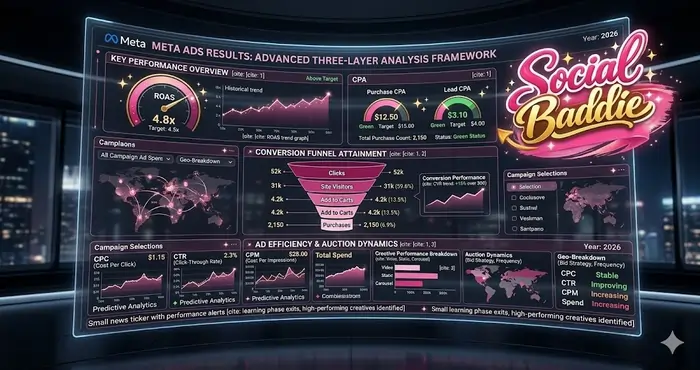
To truly master how to read Meta Ads results, you must stop looking at metrics in isolation. Professional media buyers use a layered approach to diagnose campaign health.
Layer 1: The Profitability Layer (The “What”)
This is the top-level view. Look at your ROAS and CPA first. If the campaign is hitting your target goals, your job is to stay out of the algorithm’s way.
- Result: Is the campaign profitable?
- Action: If yes, do not make any changes. If no, move to Layer 2.
Layer 2: The Conversion Layer (The “Where”)
If you are not profitable, you need to find the “leak” in the funnel. Look at your Link Click-to-Purchase ratio.
- Diagnosis: If thousands of people are clicking but nobody is buying, your website is either too slow, broken, or your value proposition is simply not compelling enough.
Layer 3: The Traffic Layer (The “Why”)
If people are not even clicking, the problem is your “Top of Funnel.” Look at your CTR and CPM.
- Diagnosis: If your CTR is 0.2%, your ad is boring. If your CPM is $50, you are likely bidding for an audience that is too competitive for your current budget.
Chapter 4: Timeframes and the “Learning Phase”
A common mistake is checking your data too often. In 2026, the algorithm needs time to gather data and optimize delivery. Here is the professional schedule for how to read Meta Ads results:
The 50-Event Rule
Meta campaigns require roughly 50 optimization events (purchases or leads) per week to exit the Learning Phase. If you analyze results before this phase is complete, you are looking at unstable data.
Daily Monitoring (The Check-In)
Spend 5 minutes looking for “Red Flags.”
- Did the spend stop entirely?
- Did the CPA spike by 300% overnight?If everything is within a 20% variance of your average, do not touch the campaign. Touching it daily resets the machine learning process and kills performance.
Weekly Analysis (The Optimization)
This is where the real work happens. Use 7 days of data to identify trends. This is when you decide which creatives to pause and which audiences to scale within The Growth Lab.
Chapter 5: Geographic and Demographic Nuance in Results
Being based in Tagum City gives me a unique perspective on how to read Meta Ads results for local vs. global markets. Data behaves differently depending on the region.
Regional CPA Variance
In the Philippines, you cannot expect a lead in Manila to cost the same as a lead in Davao. Competitive density varies by city.
- Tip: Use the “Breakdown” feature in Meta Ads Manager to see which regions are driving your best results. If Tagum City is performing better than Cebu, you can shift more budget to the winning city.
Mobile-First Philippines
In 2026, over 95% of Meta traffic in the Philippines is mobile. If you see high CPC on Desktop, it is often a sign that the algorithm is testing an inefficient ad placement. When we learn how to read Meta Ads results, we look for these placement leaks to save budget.
Chapter 6: Reading Video Creative Performance
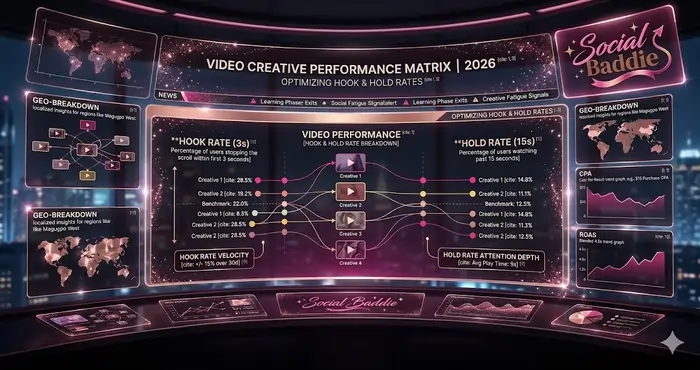
Because video is the primary driver of growth in 2026, you must understand the specific signals associated with it. Simply knowing how to read Meta Ads results from a spreadsheet is not enough; you must read the “Creative Story.”
The Hook, The Hold, and The Close
- Hook Rate: (3-Second Video Views / Impressions). Target: 25%+.
- Hold Rate: (Average Play Time / Video Length). Target: 15%+.
- The Close: (Link Clicks / 100% Video Views).
If your Hook Rate is high but your Hold Rate is low, your intro was great but the middle of your video was boring. If both are high but clicks are low, you forgot to give a strong Call to Action (CTA).
Chapter 7: Attribution and the “Data Gap”
When mastering how to read Meta Ads results, you must accept that Meta’s numbers are rarely 100% accurate.
- Delayed Attribution: A user in Tagum might see your ad on Monday, think about it on Tuesday, and finally buy on Friday. Meta might attribute that sale back to Monday, while your bank account sees it on Friday.
- Privacy Restrictions: With App Tracking Transparency (ATT) and modern tracking limitations, Meta uses “Aggregated Event Measurement” to fill in the gaps.
The Solution for Professional Media Buyers
Always cross-reference your Ads Manager results with your internal CRM or e-commerce platform (like Shopify or WooCommerce). The “Truth” is usually somewhere in the middle. At Social Baddie, we recommend using a “blended ROAS” approach to see the big picture.
Chapter 8: Signals That You Are Ready to Scale
Learning how to read Meta Ads results is not just about fixing problems; it is about spotting opportunities. You are ready to scale when:
- CPA is Stable: Your cost per result has stayed within your target for 7 consecutive days.
- Frequency is Low: Your ad frequency is under 3.0 (meaning people aren’t seeing the same ad too many times).
- Efficiency is High: You have a blended profit margin that allows you to increase spend without going into the red.
Chapter 9: Troubleshooting Performance Leaks
| Symptom | Probable Cause | Recommended Action |
| High CPM / Low Reach | Your target audience is too narrow or the auction is too competitive. | Broaden your targeting or try a “Broad Targeting” approach. |
| High CTR / Low CVR | There is a disconnect between the ad’s promise and the user experience (UX) of the landing page. | Optimize your landing page speed or clarify your offer. |
| Low CTR / High CPC | Your creative is failing to grab attention or is irrelevant to the audience. | Test a new “Hook” or a completely different visual format (UGC vs. Studio). |
Chapter 10: Advanced Auditing and Data Visualization
By 2026, reading results has become a visual science. At Adscrew PH, we don’t just look at columns; we look at the Creative Performance Matrix.
Visualizing the Click-Path
When learning how to read Meta Ads results, try to visualize your funnel as a series of gates.
- Gate 1 (The Hook): Did they stop scrolling?
- Gate 2 (The Interest): Did they watch past 15 seconds?
- Gate 3 (The Intent): Did they click the link?
- Gate 4 (The Sale): Did they check out?
If you see 1,000 people pass Gate 1 but only 5 pass Gate 3, you have a massive “Interest Leak.” This visual approach to how to read Meta Ads results makes troubleshooting instant.
The Role of Custom Conversions
Standard metrics are fine, but professional media buyers create Custom Conversions to track specific behaviors, like “Viewed 2+ Pages” or “Time on Site > 60 Seconds.” This data gives you a deeper understanding of traffic quality than a simple “Link Click” metric ever could.
Chapter 11: Scaling Your Way Out of the Learning Phase
One of the most frequent questions about how to read Meta Ads results is: “What if I can’t get to 50 conversions?”
Vertical vs. Horizontal Scaling
If your budget is too low to hit 50 purchases, you have two choices:
- Optimize for an Upper-Funnel Event: Instead of Purchases, optimize for “Add to Cart.” This gives the algorithm more data to read.
- Consolidate Your Ad Sets: Stop spreading your budget across 10 different audiences. Put all your money into 1 broad audience so the algorithm hits that 50-event mark faster.
Reading the results of a consolidated campaign is much easier because the data isn’t fragmented. At Social Baddie, we call this “Algorithmic Efficiency.”
Chapter 12: Creative Fatigue and the Refresh Cycle
As you master how to read Meta Ads results, you’ll notice that winners don’t stay winners forever. This is Creative Fatigue.
Spotting the “Drop-Off”
You know it’s time to refresh your creative when:
- Frequency increases beyond 4.0.
- CTR starts to decline consistently over 3 days.
- CPA begins to climb despite no changes to the landing page.
By proactively reading these signals, you can launch new ads before the current ones stop being profitable. This “Active Maintenance” is what separates 6-figure media buyers from everyone else.
Chapter 13: The Psychology of the 2026 Media Buyer
The most important part of learning how to read Meta Ads results is managing your own emotions. Data fluctuations are normal.
Dealing with “Bad Days”
If you check your dashboard on a Tuesday and the ROAS is 0, don’t panic. Tuesday might just be a slow day for your industry in the Philippines. Wait for the 7-day average.
The goal is to be data-driven, not data-reactive. If you react to every dip, you’ll never have a stable campaign. Trust the framework, trust the algorithm, and keep your eye on the weekly CPA.
Conclusion: Turning Data into Profitable Decisions
Mastering how to read Meta Ads results is the difference between an amateur who “burns” money and a professional who “invests” it. By focusing on the Vital Five metrics and applying the Three-Layer Framework, you remove the emotional stress of media buying.
Stop overthinking every minor fluctuation in your CPM. Instead, look for the “Why” behind the “What.” When you see a drop in performance, do not panic—diagnose. Is it the hook? Is it the offer? Is it the auction? When you can answer these questions with confidence, you have truly mastered how to read Meta Ads results.
For more advanced strategies on scaling your paid advertising, visit us at Social Baddie and let us help you turn your data into a growth engine.

