Meta Description: Learn how to create scroll stopping ads without design skills. Discover the psychology of attention, high-performance hook frameworks, and the 3-3-3 testing strategy used by expert media buyers.
If your ads are not getting clicks, the problem is rarely your targeting. In the 2026 advertising landscape, it is almost always your creative.
Before you get conversions, before you get leads, and before you can even think about scaling your ROAS — you must first win the war for attention. This guide will teach you exactly how to create scroll stopping ads without being a designer. You don’t need expensive software, a dedicated creative department, or agency-level aesthetics.
What you need is a deep understanding of psychology, a rigid structure, and a performance-first strategy. As a digital marketing specialist with over 9 years in performance advertising, I have seen thousands of ads succeed and fail. The most profitable ads were rarely the “most beautiful.” They were the clearest, most emotionally resonant, and strategically architected. Mastering this is a foundational requirement for your PPC lab notes.
The 2026 Creative Shift: Why Creative is the New Targeting
For years, media buyers obsessed over “hidden” interest groups and complex audience layering. However, with the evolution of the Meta Lattice AI, the algorithm has become incredibly efficient at finding buyers on its own.
The machine now uses your creative—specifically your hook and your copy—to understand who to show your ad to. If your ad mentions “Back Pain,” the AI scans the text and the visual elements to find people in a state of pain. If your ad is generic, the AI stays “dumb.” Therefore, learning how to create scroll stopping ads is actually your most powerful targeting tool.
The Psychology of the Scroll: Breaking the Dopamine Loop
Users do not go to social media to buy your product. They go there for a dopamine hit—a meme, a life update from a friend, or a viral Reel. To stop them, you must interrupt a biological process.
The “Zombie” Scroll
Most users are in an “autopilot” state. They are scrolling mechanically. To stop them, you need a Pattern Interrupt. This is a concept from behavioral psychology that suggests humans ignore expected stimuli but freeze when they encounter something “out of place.”
Visual Attention and Salience
According to the principles of visual attention and salience, our brains prioritize high-contrast or high-relevance information. This is why “ugly” ads often outperform polished ones—they don’t look like ads; they look like a message from a friend or a warning.
The Three Pillars of Attention
Pillar 1: The Hook (The First 3 Seconds)
The hook drives roughly 70% of your ad’s performance. If you fail here, the rest of your funnel (landing page, offer, checkout) never gets a chance to work. At Adscrew PH, we define a “Hook” as the combination of the first line of text and the first frame of your visual.
Pillar 2: Specificity (The Resonance)
Generic messages are filtered out by the brain as noise. Specificity creates a “mental hook.”
- Vague: “We help you get more customers.”
- Specific: “We help Tagum City dental clinics get 15 new patients a month without using discount offers.”
Pillar 3: Emotional Activation
Emotional marketing triggers are the “glue” that keeps someone from resuming their scroll. You must make them feel something: frustration, curiosity, fear of missing out, or the hope of a transformed future.
Step-by-Step Framework: How to Create Scroll Stopping Ads
Step 1: Mastering the Pattern Interrupt Hook
You don’t need to be a designer; you need to be a “Pattern Interrupter.” Here is a category-based swipe file of hooks we use at Social Baddie:
A. The “Negative” Call-Out
- Stop boosting posts. (Immediate authority)
- Your ads are not broken. Your message is. (Challenging beliefs)
- Why your ads get clicks but no sales. (Agitating a specific pain)
B. The Audience Call-Out
- Business owners in Davao: read this. (Geographic relevance)
- E-commerce founders, listen up. (Professional relevance)
- If you are struggling with inconsistent leads, stop scrolling. (Pain-based relevance)
C. The “Logic-Defier”
- The $0 design ad that outperformed a $10k agency video. (Curiosity)
- You don’t need better targeting; you need better hooks. (Counter-intuitive)
Step 2: The PAS Framework (Problem, Agitate, Solution)
Once you’ve stopped the scroll, you must hold the attention.
- Problem: State the specific frustration. (“Your CPA is rising every day.”)
- Agitate: Make the problem feel bigger. (“This means your profit margins are being eaten alive by Meta, and you’re working harder for less money.”)
- Solution: Introduce your offer as the relief. (“Our Growth Lab testing framework fixes your messaging architecture.”)
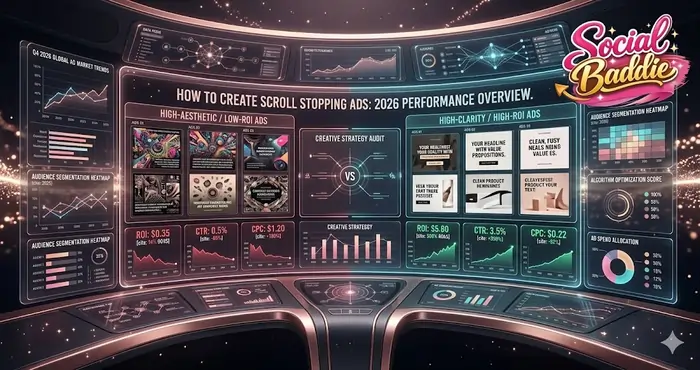
Step 3: “Ugly” Design for High Performance
If you are not a designer, don’t try to be one. Lean into “Direct Response” aesthetics.
- Screenshot Ads: Take a screenshot of a Tweet, a Slack message, or a Notes app entry. These look native to the platform.
- The “Hand-Drawn” Look: Use red circles or arrows to point at a specific benefit. This triggers the “What am I looking at?” response.
- Bold Typography: Use a plain, high-contrast background (like neon yellow or white) with big, bold black text.
Video Creative: Winning the Reels and TikTok Game
In 2026, video is king, but the rules have changed. You no longer need a film crew.
The 3-Second “Holding” Rule
If your video doesn’t have a “Visual Hook” (something moving, a text overlay, or a sudden change) every 3 seconds, you lose the user.
- The Talking Head: Ensure the person is close to the camera and uses a “Baddie” tone—candid and confident.
- Captions are Mandatory: 80% of users watch with sound off. If they can’t read your hook, they won’t stop.
- UGC (User Generated Content): This is the gold standard for non-designers. A simple video of a customer talking about their results is often more “scroll-stopping” than a 4k commercial.

Advanced Creative Testing: The 3-3-3 Model
If you want to scale profitably within The Growth Lab, you must stop guessing and start testing.
The Setup
- 3 Hooks: Test three completely different ways to start the ad.
- 3 Angles: Test three different emotional triggers (e.g., Save Time vs. Make Money vs. Beat Competitors).
- 3 Formats: Test a Static Image, a Short Video, and a Carousel.
The Metric That Matters: Hook Rate
Don’t look at ROAS first. Look at your Hook Rate (also known as the Thumb-Stop Ratio).
Hook Rate = (3-Second Video Views / Impressions) x 100
If your Hook Rate is below 25%, you aren’t stopping the scroll. No matter how good your “Solution” is, the ad will fail.
Creative Fatigue: The Professional Workflow
Even the most brilliant scroll-stopping ad will eventually die. This is called creative fatigue.
How to Spot It
- Rising CPMs: Meta starts charging more because users are “ignoring” the ad.
- Dropping CTR: The people who haven’t clicked yet are becoming “blind” to your visual.
- Frequency Spike: Your audience is seeing the same ad 3, 4, or 5 times.
The “Refresh” Protocol
Don’t delete the campaign. Iterate.
- Keep the body copy, but change the Headline.
- Keep the video, but change the first 3 seconds.
- Keep the message, but change the background color of the static graphic.
GEO Optimization for Higher Relevance
If you are targeting specific regions like Tagum City or Davao, you have an unfair advantage.
- Local Landmarks: Use a photo of a local street or landmark in the background.
- Local Dialect: Use local slang or “Taglish” if appropriate.
- Local Problems: Mention local weather or events.“Davao business owners: Tired of the heat? Here’s how to cool down your CPA.” Localizing your creative is the fastest way to increase your relevance score and lower your Cost Per Click (CPC).
Common Mistakes to Avoid
- Designing for the Client, Not the Customer: Don’t make an ad that your boss likes; make an ad that stops a stranger.
- Too Much Text: Meta’s “20% text” rule is gone, but the “Human Boredom” rule is not. Keep it punchy.
- Weak Call-to-Action: Don’t just say “Learn More.” Tell them why they should click. “Click to download the ROAS blueprint.”
- No Audience Call-out: If you don’t tell the user who the ad is for, the algorithm has to guess, which costs you money.
Knowledge Graph: Scroll Stopping Ads Matrix
| Strategic Element | Psychological Lever | Performance Impact |
| Visual Hook | Autopilot Disruption | Thumb-Stop Rate |
| Headline Hook | Curiosity / Relevance | Link CTR |
| Problem Agitation | Emotional Tension | Engagement / CPC |
| Unique Mechanism | Cognitive Relief | Conversion Rate |
| Direct CTA | Intent Alignment | ROAS / CPA |
Final Thoughts: Why This Changes Everything
Most advertisers spend their time fighting the algorithm. They change their bid strategies, their budgets, and their audiences.
Experienced media buyers know that Creative is the only lever left. If you master how to create scroll stopping ads, you stop fighting the machine and start feeding it. You increase your CTR, you lower your CPA, and you allow your brand to scale in ways that were previously impossible.
You don’t need to be an artist. You need to be an observer of human behavior. Master these principles in our PPC lab notes and turn your ad account into a growth engine.
Would you like me to help you draft three “Pattern-Interrupt Hooks” for your next campaign, or shall we generate a 2026 futuristic dashboard image to visualize your performance growth?

