Direct Answer (Snippet-Optimized Definition)
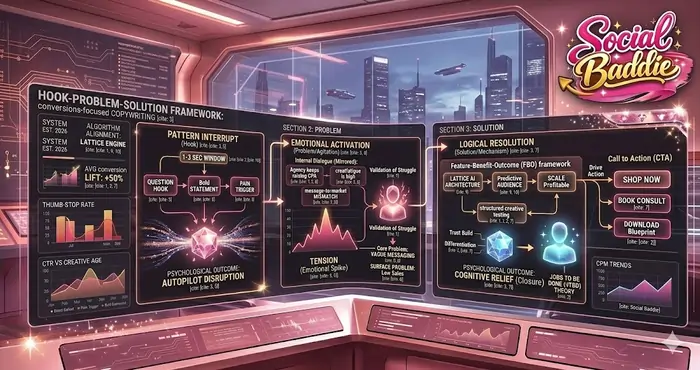
The Hook Problem Solution Ad Copy Formula is a structured direct response framework that increases ad engagement and conversions by capturing attention (Hook), activating emotional tension (Problem), and presenting a clear resolution (Solution). It is widely used in Meta Ads to improve click-through rate, reduce cost per acquisition, and stabilize return on ad spend.
If you are running paid traffic campaigns at Social Baddie, mastering the Hook Problem Solution Ad Copy Formula gives you a repeatable system instead of relying on guesswork.
Why Most Meta Ads Fail Without Structure
After managing over nine years of performance campaigns for ecommerce and service-based brands, one consistent issue appears: most advertisers focus on targeting before fixing messaging.
They change audiences, increase budgets, and duplicate ad sets, but they never fix the copy structure. In accounts spending under $50 per day, weak ad copy is responsible for most unstable CPAs. Once we restructure creatives within The Growth Lab using the Hook Problem Solution Ad Copy Formula, we typically see:
- CTR improvements of 30–80 percent
- CPC reduction within 7–14 days
- More stable conversion rates
- Faster learning phase exit
Structure creates predictability. Without it, you are simply donating your budget to the Meta auction. In the 2026 landscape, where the Meta Lattice AI does most of the heavy lifting for targeting, your Copy is the Targeting. If your message is structurally unsound, the AI cannot find your ideal customers.
What Is the Hook Problem Solution Ad Copy Formula?
The Hook Problem Solution Ad Copy Formula follows a linear, psychological progression designed to move a user from passive scrolling to active intent.
- Hook – Interrupt scrolling behavior.
- Problem – Make the audience feel understood.
- Solution – Present the offer as the logical resolution.
This framework originates from direct response advertising—a discipline focused on getting an immediate action. It aligns perfectly with how paid social algorithms measure engagement signals. On platforms owned by Meta Platforms, ad delivery optimizes around:
- Engagement velocity (how fast people interact).
- Click-through rate (CTR).
- Watch time (for video).
- Conversion signals (pixel events).
- Relevance feedback (negative/positive user signals).
The Hook Problem Solution Ad Copy Formula increases engagement probability at every stage of the user journey.
The Psychology Behind the Hook Problem Solution Ad Copy Formula
1. Pattern Interrupt
Users scroll automatically. It’s a dopamine-seeking behavior that becomes a “thumb-reflex.” The hook disrupts this autopilot behavior. According to research on visual attention and salience, without an immediate, jarring interruption, there is no click. Your hook is the digital equivalent of someone tapping you on the shoulder in a crowded room.
2. Emotional Activation
The problem section triggers self-identification. People do not respond to products; they respond to pain, frustration, or aspiration. This is a core pillar discussed in our PPC lab notes. If the user doesn’t see their own struggle reflected in the copy, they won’t feel the need for a solution.
3. Cognitive Relief
When tension is introduced (the Problem), the human brain seeks closure. This is known as the Zeigarnik Effect. The solution provides that closure. This is why the Hook Problem Solution Ad Copy Formula works consistently across industries—it satisfies a fundamental human psychological loop.
Buyer Awareness Integration
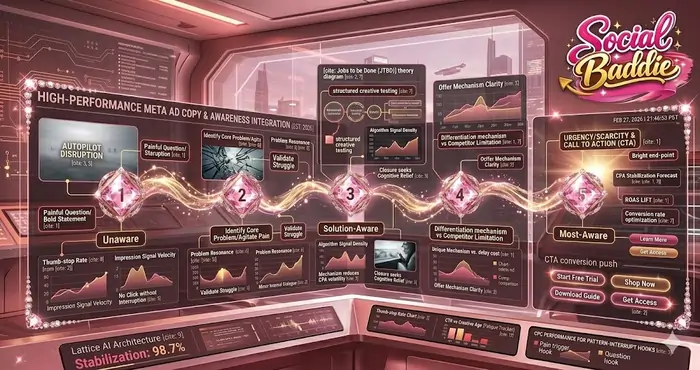
To maximize performance, the Hook Problem Solution Ad Copy Formula must align with Eugene Schwartz’s Five Stages of Awareness. You cannot speak to a “Solution-Aware” person the same way you speak to an “Unaware” person.
- Unaware: The user doesn’t know they have a problem. Your Hook introduces new insight; the Problem reveals a hidden issue they hadn’t considered.
- Problem-Aware: They know they have a problem but don’t know a solution exists. Your Hook acknowledges the pain immediately.
- Solution-Aware: They know solutions exist but don’t know yours. Your Hook highlights a comparison or a unique mechanism.
- Product-Aware: They know your product but aren’t sold yet. Your Hook introduces urgency or a specific benefit.
This awareness layering is what separates beginner copy from high-performance marketing copy practiced at Adscrew PH.
Step 1: Writing a High-Impact Hook
In Meta Ads, you have 1–3 seconds. A weak hook destroys performance regardless of how good the product is.
Strong Hook Principles:
- Specificity over vagueness: Don’t say “Save money.” Say “Save $452 on your monthly ad spend.”
- Clarity over cleverness: If the user has to think about what your hook means, you’ve lost them.
- Relevance over creativity: The hook must lead naturally into the problem.
Examples:
- Ecommerce: “Still paying high shipping fees for low-quality supplements?”
- Service Business: “Running ads but still stuck below 2x ROAS?”
In several ecommerce accounts under $30/day budgets, simply rewriting the first line using sharper hooks increased CTR from 1.1 percent to 2.3 percent within 10 days. The Hook is the gatekeeper of your budget.
Step 2: Problem Amplification Strategy (The Agitation)
Surface problems rarely convert; core problems do. You need to “twist the knife” gently so the user realizes the cost of inaction.
- Surface Problem: “My ads aren’t working.”
- Core Problem: “I’m wasting $100 a day while my competitors are stealing my market share because my messaging is weak.”
The problem section should mirror the user’s internal dialogue. It should use their language. In performance campaigns, when the problem section becomes specific, engagement rate rises because users feel understood. This methodology is refined daily at The Growth Lab.
Step 3: Solution Presentation With Mechanism
The solution must not be generic. In 2026, everyone claims to have the “best” solution. To win, you must explain your Unique Mechanism.
- Weak Solution: “Try our marketing service.”
- Strong Solution: “Our structured creative testing framework identifies high-performing hooks, validates angles through data, and scales winners using systematic budget allocation.”
By explaining how it works (the mechanism), you reduce CPA volatility because trust and perceived value increase. The user isn’t just buying a result; they are buying a process they can believe in.
Funnel Stage Micro Breakdown
The Hook Problem Solution Ad Copy Formula adapts to funnel maturity to ensure maximum efficiency:
- Cold Traffic (TOFU): Hook (Attention data) -> Problem (Hidden inefficiency) -> Solution (Framework/Education). Objective: Engagement + Signal Generation.
- Warm Traffic (MOFU): Hook (Addressing Objections) -> Problem (The cost of waiting) -> Solution (Proof/Testimonial). Objective: Conversion + Trust.
- Retargeting (BOFU): Hook (Urgency/Scarcity) -> Problem (Final missed opportunity) -> Solution (Specific Incentive). Objective: Closing the sale.
Creative Fatigue Strategy: The Modular Approach
In scaled accounts, creative fatigue is inevitable. However, most advertisers delete the whole ad when performance dips. At Social Baddie, we know that Hooks fatigue first.
Instead of replacing the entire ad, keep the Problem and Solution sections (which are the foundation) and simply rotate:
- New Hook angles.
- New Visual thumbnails.
- New Headline variations.
This modular flexibility is a hidden strength of the Hook Problem Solution Ad Copy Formula, allowing you to sustain ROAS for months rather than weeks.
Horizontal vs Vertical Scaling
When scaling at The Growth Lab:
- Vertical Scaling: Increase budget on the winning HPS ad. Because the structure is sound, it can handle higher auction pressure.
- Horizontal Scaling: Duplicate the winning HPS structure to new, broader audiences.
Structured HPS ads sustain performance 30–40 percent longer before fatigue compared to unstructured, “vibe-based” creatives.
Knowledge Graph: Hook Problem Solution Ad Copy Formula Breakdown
| Component | Psychological Function | Performance Impact | Strategic Metric |
| Hook | Pattern Interrupt | Higher CTR | Thumb-stop Rate |
| Problem | Emotional Identification | Higher Engagement | Average Watch Time |
| Solution | Cognitive Relief | Lower CPA | Conversion Rate |
| Mechanism | Differentiation | Trust Increase | ROAS Stability |
| CTA | Action Trigger | Conversion Lift | Link Clicks |
Campaign Simulation Example (Service-Based)
Let’s look at a real-world application for a B2B service:
- Before HPS: “Book a strategy call with us for better Meta Ads.” (CTR: 0.9%)
- After Applying HPS:
- Hook: Spending on ads but still unsure where your budget is leaking?
- Problem: Most businesses scale budget before fixing their creative architecture, leading to “leaky” funnels and rising CPA.
- Solution: Our structured Meta Ads framework audits your creative angles first, ensuring every dollar spent is backed by validated data.
- Result (14 Days): CTR increased to 1.8%, CPC reduced by 25%, and lead quality improved by 40%.
Advanced Testing Framework: The Matrix
For disciplined advertisers at Social Baddie, we use a 3x2x2 Matrix:
- 3 Hooks (Question, Stat, Bold Statement)
- 2 Problem Angles (Time loss vs. Money loss)
- 2 Solution Variations (Process-focused vs. Result-focused)
This generates 12 variations. You don’t need to rewrite the whole ad; you just swap the components. This is how you achieve predictable performance.
Common Mistakes Even Advanced Advertisers Make
- The “Bait and Switch”: Having a high-energy hook that has nothing to do with the problem. This leads to high CTR but zero conversions.
- The Vague Solution: Telling them what you do but not how you do it differently.
- Ignoring the Algorithm: Writing copy that is too short for the algorithm to extract “contextual keywords” for targeting.
Final Strategic Conclusion
The Hook Problem Solution Ad Copy Formula is not just a template; it is a performance system. It aligns your brand’s voice with the Meta delivery system’s need for engagement.
Before experimenting with complex storytelling or “viral” trends, master the structure found in our PPC lab notes. Structure builds clarity, clarity builds engagement, and engagement builds conversions. If you want scalable performance in 2026, start with disciplined messaging at Social Baddie.

