
Overview
If your CPA is rising, Audience Targeting Mistakes in Meta Ads might be the real problem. Most beginners blame creatives, the offer, or the ever-changing algorithm, but in over nine years of running performance campaigns, I’ve seen a specific pattern: Audience Targeting Mistakes in Meta Ads silently destroy profitability before your creative assets even get a fair chance to perform. At Social Baddie, we treat account architecture as the foundation of growth. If your targeting sends conflicting or weak signals to the Meta Ads delivery system, the machine learning engine simply cannot optimize for your bottom line.
This guide, developed within The Growth Lab, serves as a deep-dive audit for advertisers who want predictable scaling rather than random wins. We will break down the structural failures that drain budgets and provide a data-backed framework to align your strategy with modern privacy standards set by the IAB.
The Core Philosophy: Why Structure Trumps “Hacks”
To fix Audience Targeting Mistakes in Meta Ads, we must first shift our mindset. In the early days of Facebook advertising, success was often found through “interest hacking”—finding that one secret interest group that no one else was targeting. In 2026, that strategy is obsolete. Meta’s AI is now so advanced that it is better at finding your customers than you are.
The problem is that many advertisers still try to “steer” the algorithm by giving it too many rules. Every interest you add, every age bracket you narrow, and every placement you exclude is a restriction. When you restrict the machine, you prevent it from doing its job: finding the cheapest conversion. Modern PPC is about collaboration with the AI, not control over it.
The 12 Most Expensive Audience Targeting Mistakes in Meta Ads
1. Over-Narrowing Interests (The “Precision Trap”)
One of the most frequent Audience Targeting Mistakes in Meta Ads is “Interest Stacking.” Beginners often believe that layering Interest A AND Interest B AND Behavior C creates a “laser-targeted” audience. In reality, this shrinks the available audience size too aggressively.
When the pool is too small, Meta’s AI lacks the “room” to explore and find the lowest-cost conversions. This leads to high CPMs because you are bidding against everyone else in a tiny, competitive auction. If your audience is under 1 million in a major market like the US, you are likely falling into this trap.
2. Targeting Based on Assumption Instead of Data
Many advertisers target what “sounds right”—targeting luxury brands for a premium product, for instance. However, assumptions are not performance indicators. Effective PPC strategies rely on hard pixel data and the Meta Conversions API to identify who is actually converting.
Oftentimes, your real buyer might not have any affinity for luxury brands; they might just be a high-earning professional who values time over status. If you target the “brand,” you miss the “buyer.”
3. Ignoring Broad Targeting
In the 2026 landscape, “Broad” is often the most efficient targeting option. Broad targeting allows the algorithm to locate hidden buyer clusters that manual interest selection would miss. Avoiding this is a common Audience Targeting Mistake in Meta Ads that limits your ability to scale beyond niche pockets. Broad targeting relies on your Creative to do the filtering, which is the most sustainable way to target in a privacy-first world.
4. Poor Funnel Segmentation
Mixing cold, warm, and hot audiences within a single ad set creates “Signal Noise.” When you lump new prospects with past buyers, the algorithm doesn’t know who to prioritize. To fix this, you must segment your funnel clearly:
- Prospecting (Cold): Users who have never interacted with you.
- Re-engagement (Warm): Social engagers and video viewers.
- Retargeting (Hot): Website visitors and abandoned carts.
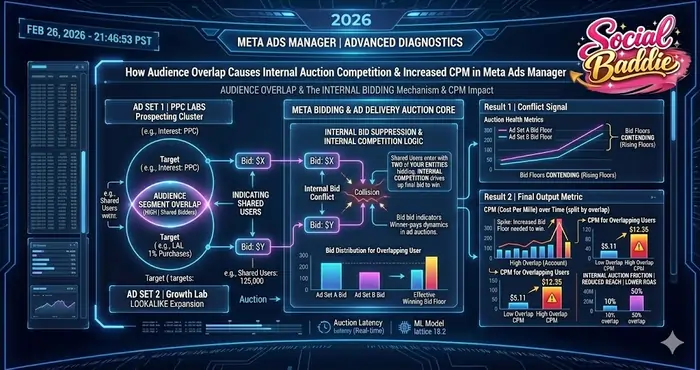
5. Audience Overlap and Auction Competition
When two or more of your ad sets target the same users, they compete against each other in the auction. This drives up your internal bidding costs and fragments your data. Audience Overlap is among the most invisible Audience Targeting Mistakes in Meta Ads, often caught only through the Meta Inspect Tool.
6. No Exclusion Strategy
If you aren’t excluding recent purchasers from your prospecting campaigns, you are paying to acquire a customer you already have. This is a fundamental Audience Targeting Mistake in Meta Ads that inflates your CPA. Always implement a 30 to 180-day purchaser exclusion to keep your prospecting “clean.” This ensures every dollar is spent on finding new business.
7. Using 1% Lookalike Without Sufficient Seed Data
Lookalike audiences (LLAs) are only as good as the source data. If your seed audience (e.g., a customer list) is small or contains low-intent users, a 1% LLA will be unstable. High-level PPC managers often find that broader 3% or 5% LLAs—or even “Stacked LLAs”—perform better because they give the algorithm more data points to work with.
8. Scaling Through Duplication (Horizontal) Instead of Vertical Scaling
Beginners often duplicate a winning ad set to “double the results.” This is a mistake. Duplication fragments your conversion data, making it harder for any single ad set to exit the Learning Phase. Instead, use vertical scaling by increasing the budget of the winning ad set by 10-20% every 48 hours. This keeps the “momentum” in the original ad set.
9. Retargeting Windows That Are Too Small
For accounts with lower traffic volume, a 7-day retargeting window usually doesn’t provide enough events for the algorithm to optimize. This is a major Audience Targeting Mistake in Meta Ads. If you only have 500 visitors a week, a 7-day window only gives Meta a few dozen people to target. Adjust your windows to 30 or 60 days to give the machine enough “signal density” to work effectively.
10. Ignoring GEO Performance and Localization
Lumping all countries or regions into one ad set ignores the reality of geographic performance variance. You must isolate and optimize for high-performing geographies to ensure your budget is allocated where the ROAS is naturally higher. A lead in New York is priced differently than a lead in Tagum City; treating them the same is a waste of budget.
11. Fragmenting Budgets Across Too Many Ad Sets
Data liquidity is king. If you have a $100 daily budget spread across 10 ad sets, none of them will gather enough data to exit the Learning Phase. Consolidation is the cure for this common Audience Targeting Mistake in Meta Ads. In 2026, the fewer ad sets you have, the more the AI can learn.
12. Changing Targeting Too Frequently
Every time you make a “significant edit” to your targeting, the ad set goes back into the learning phase. Success requires the patience to let the data compound. Constant tinkering is a psychological trap that sabotages long-term performance. If you don’t let it run for at least 7 days, you haven’t actually tested anything.
The Technical Underpinnings: Machine Learning & Signal Clarity
To truly fix Audience Targeting Mistakes in Meta Ads, you have to understand how the Meta delivery system works under the hood. Meta uses a system called “Lattice” and “Andromeda” to process signals.
The Importance of “Clean” Signals
The algorithm is a prediction engine. It looks at your targeting and says, “Who in this pool is most likely to click and buy?” If your targeting is fragmented or overlaps, you are giving the engine “dirty” data. You are essentially asking it to solve two different problems at the same time. By simplifying your audience structure, you provide Signal Clarity, which allows the AI to predict conversions with much higher accuracy.

Knowledge Graph: Core Structures Behind Audience Targeting Mistakes in Meta Ads
| Element | Operational Meaning | Strategic Impact |
| Broad Targeting | No interest/behavior filters | Lower CPM, higher scalability |
| Audience Overlap | Multiple sets targeting same users | Inflated costs, fragmented data |
| Learning Phase | AI data collection period | Requires 50 conversions/week to stabilize |
| Exclusion Logic | Removing converters from ads | Protects ROAS, reduces waste |
| CAPI Signal | Server-side conversion data | Restores data loss from privacy updates |
Export to Sheets
Step-by-Step Framework to Fix Your Meta Ads Targeting
To move from unstable campaigns to a scalable architecture, follow this framework refined at The Growth Lab:
Phase 1: Audit and Consolidate
Go into your Ads Manager and look at your “Inspect” tool. Are your ad sets competing against each other? If so, merge them. Move from dozens of niche ad sets to 2-3 consolidated sets:
- Broad Prospecting: Completely open (No interests).
- Lookalike Prospecting: Using high-intent seeds (Purchasers/Add to Carts).
- Dynamic Retargeting: For warm/hot audiences.
Phase 2: Implement Hard Exclusions
Ensure every prospecting campaign has a robust “Purchaser Exclusion.” This is non-negotiable. If you don’t exclude them, Meta will naturally show ads to them because they are the most likely to engage, creating a “false positive” ROAS that isn’t actually driving new growth.
Phase 3: Budget Realignment
Ensure your daily budget is at least 3-5x your target CPA. If your target CPA is $20, but your ad set budget is only $10, you are mathematically unlikely to ever exit the learning phase. You must give the algorithm enough capital to “buy” the data it needs.
Phase 4: Signal Restoration
Implement the Conversions API. This is the technical solution to the “Targeting Mistake” of signal loss. By sending data directly from your server, you ensure Meta has the full picture of your conversions, regardless of browser privacy settings.
Case Study: The Cost of Fragmentation
At Social Baddie, we audited a client spending $5,000/month who had 15 different interest-based ad sets. Their average CPA was $45. We consolidated those 15 ad sets into 2 (1 Broad, 1 LLA).
Within 14 days:
- CPM decreased by 35% (less auction competition).
- CPA dropped to $28 (stable learning phase).
- ROAS increased by 40%.
The “Targeting Mistake” wasn’t the interests themselves—it was the Fragmentation of the budget that prevented the AI from working.
Final Strategic Conclusion
Audience Targeting Mistakes in Meta Ads are rarely fatal in isolation, but they act as a “tax” on your profitability. They create friction where there should be flow. By cleaning up your architecture and moving toward a signal-based optimization model, you allow Meta to do what it does best: find your customers at the lowest possible cost.
Structure determines outcome. In performance marketing, a messy account will always produce messy results. Before you scrap your creatives or fire your media buyer, audit your audience logic at Social Baddie. Focus on consolidation, exclusion, and signal clarity.
Would you like me to audit a specific ad set structure for you, or shall we generate a Creative Hook Framework to ensure your messaging aligns with your new broad targeting strategy?

