In 2016, SEO certifications felt impressive.
In 2020, they felt necessary.
In 2026, they feel crowded.
Scroll LinkedIn for five minutes and you’ll see:
- Google‑certified digital marketer
- SEO bootcamp graduate
- HubSpot SEO certified
- AI SEO specialist
- Search marketing certification completed
But here’s the uncomfortable truth:
If certifications alone built expertise, the internet would be perfectly optimized by now.
It isn’t.
Because SEO is not a credential.
SEO is a skill.
And skill cannot be downloaded.
It must be built.
For more Insight Read: SEO Careers: Skills and Growth Paths (2026)
The Certification Illusion in SEO
Certifications can:
- Provide structured learning
- Introduce terminology
- Teach basic frameworks
But they do not prove you can execute.
Google itself does not offer an official “SEO certification.” Instead, Google’s own How Search Works documentation explains ranking as a system of signals — relevance, quality, usability, and context — rather than something tied to any credential.
Search performance is based on:
- Relevance
- Quality
- Usability
- Context
Not whether someone passed a course.
A certificate shows completion.
SEO skill shows execution.
What Modern SEO Actually Requires (2026 Reality)
Google’s Search Quality Evaluator Guidelines outline how content is assessed using E‑E‑A‑T — experience, expertise, authoritativeness, and trustworthiness — as a lens for quality. That alone tells you something important:
SEO is about signals of real expertise — not badges.
Modern SEO requires understanding:
- Search intent modeling
- Semantic relevance and entities
- Structured data and schema
- Core Web Vitals and UX
- Technical crawlability and indexing
- AI‑driven search and answer systems
Google’s Core Web Vitals documentation shows how metrics like LCP, CLS, and INP directly influence page experience signals and can affect search performance.developers.
You don’t optimize those with theory.
You optimize them with hands‑on testing.
Technical SEO: Where Theory Collapses
Technical SEO separates practitioners from learners.
You must understand:
- Crawlability
- Indexability
- Canonicalization
- Redirect chains
- JavaScript rendering
- Log file analysis
Google’s crawling and indexing overview explains how Googlebot discovers, crawls, and indexes pages, how signals like robots.txt, sitemaps, and canonical tags interact, and why implementation details matter.
If a site loses 40% of traffic after a migration, a certificate won’t save it.
Understanding crawl behavior and indexation will.
Execution wins.
SEO Is a Systems Skill
SEO is not a single tactic.
It is a system.
Google’s ranking systems guide describes multiple overlapping systems — helpful content, spam detection, product reviews, core ranking, and more — that work together rather than one monolithic “algorithm.”
This includes:
- Helpful content systems
- Spam systems
- Reviews systems
- Core ranking systems
You cannot “memorize” ranking systems into performance.
You must adapt strategically as they evolve.
That requires applied skill, not just conceptual familiarity.
AI Has Raised the Standard
In 2026, AI tools can generate content on demand.
But Google’s guidance on AI‑generated content, in posts like “Google Search and AI‑generated content”, makes something clear: helpful, people‑first content that demonstrates genuine value and expertise matters more than whether AI was used.
AI does not replace:
- Intent alignment
- Editorial judgment
- Content architecture
- Authority development
AI amplifies skilled SEOs.
It exposes shallow ones.
Analytics Literacy: The Overlooked Skill
Many certified practitioners know what GA4 is.
Few can extract strategic insight from it.
Google’s GA4 property setup and reporting documentation explains event‑based data, exploration reports, and attribution models — but it doesn’t automatically teach you which metrics matter for SEO decisions.
Real SEO skill includes:
- Query‑level CTR gap analysis
- Impression and position trend interpretation
- Cannibalization detection in Search Console
- Conversion alignment with organic traffic
Without analytics literacy, SEO becomes guesswork.
Structured Data & Schema Skill
Schema markup improves structured clarity and eligibility for rich results.
Google’s introduction to structured data explains how markup helps search systems interpret content types, relationships, and entities more accurately.
You don’t become proficient at schema by reading about it.
You become proficient by:
- Implementing and testing markup
- Validating with tools and fix cycles
- Monitoring rich result impressions and clicks
- Iterating implementations based on outcomes
Again:
Execution > certificate.
The Market Is Shifting Toward Proof of Work
LinkedIn’s talent research on skills‑based hiring highlights a clear shift: more employers are moving from degree‑ and credential‑based filters toward verified skills, portfolios, and on‑the‑job capability.
In SEO specifically, hiring managers increasingly ask for:
- Case studies
- Ranking proof
- Traffic and revenue growth examples
- Portfolio samples
- Technical audits
Not badge screenshots.
Because ranking requires applied capability.
SEO Careers in 2026: Skill Over Credential
The U.S. Bureau of Labor Statistics overview for computer and IT occupations projects faster‑than‑average growth for digital and analytics‑heavy roles through 2034, including web, data, and search‑related careers.
These roles emphasize:
- Analytical thinking
- Technical proficiency
- Adaptability
Not certification accumulation.
SEO sits inside this broader digital skill economy.
And digital skills are execution‑based.
The Skill‑Building Blueprint
If you want to build real SEO skill:
1. Launch a Site
Nothing replaces ownership.
When it’s your site, you learn:
- Indexation issues
- Internal linking logic
- Content gaps
- Technical regressions
- Algorithm volatility
2. Study Algorithm Updates
Google publishes core update notes and guidance for site owners in the Search Central blog, explaining what types of improvements are recommended rather than listing direct ranking factors.
Reading update notes and observing impact builds pattern recognition.
3. Conduct Experiments
Test:
- Title and meta changes
- Content expansion and restructuring
- FAQ and other schema types
- Internal linking density and hierarchy
- Page speed and Core Web Vitals improvements
Monitor performance in Search Console and analytics.
Learn through iteration, not assumption.
The AI Era Requires Deeper Skill
Search is evolving toward AI‑driven overviews and generative experiences.
Google’s product updates on the Search blog and AI features show how search is moving toward context‑aware summaries, entity‑rich experiences, and multi‑step reasoning in results.
This means SEO now requires:
- Context building around entities and topics
- Clear information architecture
- Consistent signals of expertise and authority
- Content that is easy for both users and models to interpret
Surface‑level knowledge will not survive this shift.
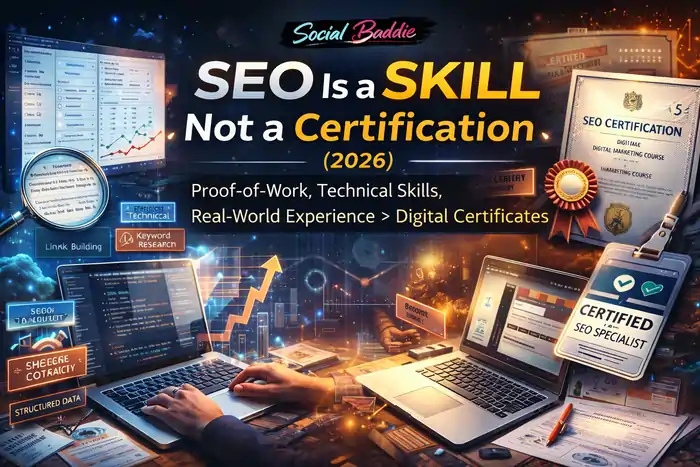
Infrastructure Over Identity | SEO Is a Skill, Not a Certification (2026)
Certifications are not evil.
They are incomplete.
Google does not reward credentials.
It rewards:
- Relevance
- Clarity
- Experience
- Authority
- Technical stability
- User satisfaction
SEO in 2026 is infrastructure.
Infrastructure requires skill.
And skill requires:
- Practice
- Failure
- Repetition
- Adaptation
- Long‑term thinking
Stop collecting badges.
Start building capability.
Because search engines rank performance.
Not paper.

