
In 2015, certifications felt like leverage.
In 2020, they felt like survival.
In 2026, they feel… crowded.
Scroll LinkedIn for five minutes and you’ll see:
- Google Analytics certified
- Meta Blueprint certified
- HubSpot Inbound certified
- Coursera specialization completed
- AI prompt engineering bootcamp finished
But here’s the uncomfortable question:
Are certificates actually moving careers forward?
Or are they just signaling effort without proving execution?
In 2026, the real debate is no longer education vs no education.
It’s certificates vs skills — and what actually creates income, mobility, and long‑term career capital.
The Certificate Boom (And Why It Happened)
Over the last decade, we saw a rise in:
- Online certifications
- Digital badges
- Micro‑credentials
- Short‑term bootcamps
- Remote learning platforms
Why?
Because traditional degrees became expensive and slow, while digital transformation accelerated faster than universities could update curricula. At the same time, global workforce reports began highlighting rapid skill turnover. The World Economic Forum’s Future of Jobs Report 2025 notes that roughly 40% of workers’ core skills are expected to change within just a few years, reinforcing the urgency of ongoing reskilling and upskilling.reports.
Certificates filled the gap between:
College degree ↔ Self‑taught chaos
But here’s the shift happening in 2026:
Recruiters are now overwhelmed with certificates.
And they’re asking a sharper question:
“Can this person actually do the work?”
What Is the Real Difference Between Certificates and Skills?
Let’s simplify it.
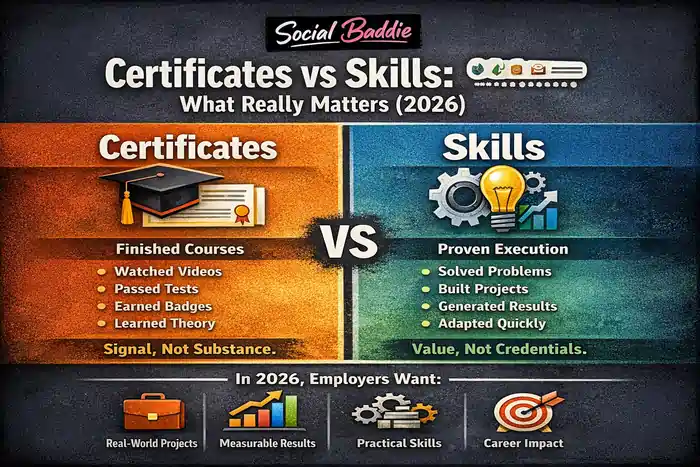
Certificate = proof you completed a curriculum.
Skill = proof you can execute in real conditions.
A certificate shows:
- You watched the videos
- You passed the assessment
- You completed the modules
A skill shows:
- You solved a problem
- You improved performance
- You generated measurable results
- You handled friction
This shift aligns with the growing trend of skills‑based hiring, which LinkedIn documents in its Skills‑Based Hiring insights, showing employers moving from pedigree‑based filters toward verified skills and portfolio proof.
In a competency‑based hiring economy, execution beats completion.
Certificates are static.
Skills are dynamic.
And markets reward dynamic capability.
Why Certificates Alone Don’t Create Leverage
Here’s what many early‑career professionals miss:
Certificates do not automatically translate into market‑ready skills.
You can:
- Finish a Google Ads course
- Pass a HubSpot content exam
- Complete a data analytics certificate
…and still not know how to:
- Interpret real campaign data
- Diagnose ranking drops
- Debug tracking issues
- Optimize a funnel under budget pressure
Execution requires context.
Context requires friction.
Friction builds skill.
This is especially clear in SEO.
Google itself explains how search ranking works — relevance, quality, and usability — in its How Search Works documentation. Ranking isn’t about memorizing theory; it’s about applying structured logic to real websites and systems.
The Rise of Skills‑Based Hiring (2026 Reality)
The degree vs skills debate has matured.
Now it’s certificates vs applied competency.
Companies are shifting toward:
- Competency‑based hiring
- Portfolio evaluation
- Scenario testing
- Practical interviews
The U.S. Bureau of Labor Statistics overview of computer and IT occupations projects these roles to grow much faster than average between 2024 and 2034, and many of those paths emphasize demonstrable skills over formal academic credentials.
Why?
Because automation is replacing repetitive knowledge work.
AI tools can now:
- Generate campaign drafts
- Write content
- Build reports
- Suggest optimizations
But AI cannot replace:
- Strategic judgment
- Systems thinking
- Revenue interpretation
That’s why the highest‑paying jobs without a degree increasingly require analytical depth — not just certificates.
High‑Income Skills vs Certifications (Where Money Actually Flows)
1. SEO Certifications vs SEO Skills
There are many SEO certifications available.
But ranking pages requires:
- Technical SEO audits
- Internal linking strategy
- Search intent mapping
- Semantic optimization
- Core Web Vitals improvement
Google’s Core Web Vitals documentation shows how loading speed, interactivity, and visual stability directly affect search performance and user experience. That’s execution‑level knowledge.developers.
If someone wants to understand what real SEO skill progression looks like, they should study Social Baddie’s roadmap for SEO careers. That page outlines real development paths — not just job titles.
Because in SEO:
Results matter more than certifications.
2. Data Analytics Certifications vs Data Literacy
You can complete a Google Analytics certification.
But can you interpret attribution?
Google explains data‑driven attribution in its GA4 documentation, showing how machine learning distributes credit across touchpoints based on incremental contribution rather than last‑click rules. Understanding how credit is assigned across a journey is skill‑level thinking — not certificate‑level.
Data literacy in 2026 means connecting traffic to revenue.
Not decorating dashboards.
3. Performance Marketing Certificates vs Revenue Skills
Google’s Ads auction overview breaks down how ad rank is influenced by bid, ad quality, and expected impact — not just budget — which is the foundation for real optimization.
You can be certified in Google Ads.
But can you:
- Reduce CAC?
- Improve ROAS?
- Manage volatility?
- Scale profitably?
Revenue skills compound.
Certificates expire.
The Psychology Trap: Progress Theater
There’s something comforting about certificates.
They give:
- Immediate validation
- Visible achievement
- Social proof
But real skill development feels slower.
Because skill building includes:
- Failed tests
- Traffic drops
- Budget mistakes
- Campaign adjustments
McKinsey’s research on capability building and digital transformation shows that companies which invest in deep skill development and behavior change outperform those that focus on surface‑level tool adoption or one‑off training badges.
Capability building > badge collecting.
Skill Stacking: The Real Advantage
The future of work favors interdisciplinary operators.
The WEF skills outlook for the future of work emphasizes analytical thinking, resilience, flexibility, and technology literacy as top growth skills for the next decade.digital-skills-jobs.
Skill stacking examples:
- SEO + copywriting
- Paid media + analytics
- CRO + user psychology
- Automation + funnel strategy
This is how you increase career resilience and optionality.
Alternatives to College Degree (That Actually Build Skills)
Instead of chasing more certifications:
Build projects.
Launch:
- A niche content site
- A content cluster around one topic
- A small but real paid media test campaign
- A simple automation workflow that saves time
Ownership builds competence.
Document your work.
Publish:
- Case studies
- Lab notes
- Experiments and post‑mortems
That’s exactly the philosophy behind Social Baddie — structured learning through execution, not just theory.
Future‑Proof Skills in the AI Economy
AI is not eliminating careers.
It is filtering shallow knowledge.
Future‑proof skills include:
- Prompt literacy
- Systems thinking
- Automation strategy
- Data interpretation
- Technical debugging
GitHub’s Octoverse report consistently highlights languages like Python and JavaScript as globally dominant, reinforcing sustained demand for applied technical skills that sit underneath AI tools and automation layers.
AI amplifies skilled operators.
AI replaces repetitive, certificate‑level knowledge.
Final Perspective: Certificates vs Skills
In 2026, we are operating in a proof‑of‑work economy.
That means:
- Skill > Certificate
- Execution > Completion
- Assets > Credentials
- Judgment > Information
Certificates can open doors.
Skills build rooms.
If you want career mobility and income leverage, focus on:
- High‑income skills
- Skill stacking
- Project ownership
- Real‑world testing
- Documented results
And if you’re building a career in SEO specifically:
Don’t just collect SEO certifications.
Study real progression.
Build real projects.
Understand systems.
Because the market doesn’t reward what you completed.
It rewards what you can build.

